

 12 hours ago
1
12 hours ago
1
PROTECT YOUR DNA WITH QUANTUM TECHNOLOGY
Orgo-Life the new way to the future Advertising by AdpathwayWhy does the effortless, rhythmic swing you discovered on the practice range often vanish the moment your spikes touch the first tee? It’s a frustrating paradox that defines the amateur experience, yet the solution rarely lies in more swing repetitions; instead, it requires a sophisticated understanding of sports psychology for golfers. You’ve likely felt that familiar surge of anxiety after one bad hole or the slow bleed of focus during a mid-round slump. These aren’t failures of talent, but failures of preparation.
This 2026 mental performance guide is designed to help you stop fighting your own mind and start building the psychological architecture of an elite player. You’ll learn how to bridge the gap between your range game and the first tee by mastering internal stability and resilience. We’ll explore the structured routines and cognitive control mechanisms that allow you to lower your scores without a single mechanical adjustment. It’s time to master the 90% of the game that happens between the shots, moving from frantic effort to a state of calm, repeatable confidence.
Key Takeaways
- Understand why technical skills often fail to transfer from the range to the course by identifying the psychological shift caused by perceived consequence.
- Discover how modern sports psychology for golfers functions as “mental architecture,” providing a structured framework for emotional regulation and focus management.
- Learn to implement a three-phase routine that acts as a disciplined safety blanket for the brain, reducing uncertainty during high-pressure moments.
- Identify the cognitive “short circuits” behind the yips and choking to prevent your conscious mind from interfering with automated performance.
- Build a sustainable path toward mental mastery using off-course tools like performance audios and deliberate journaling to reinforce on-course resilience.
The Range vs. Course Paradox: Why Your Swing Deserts You
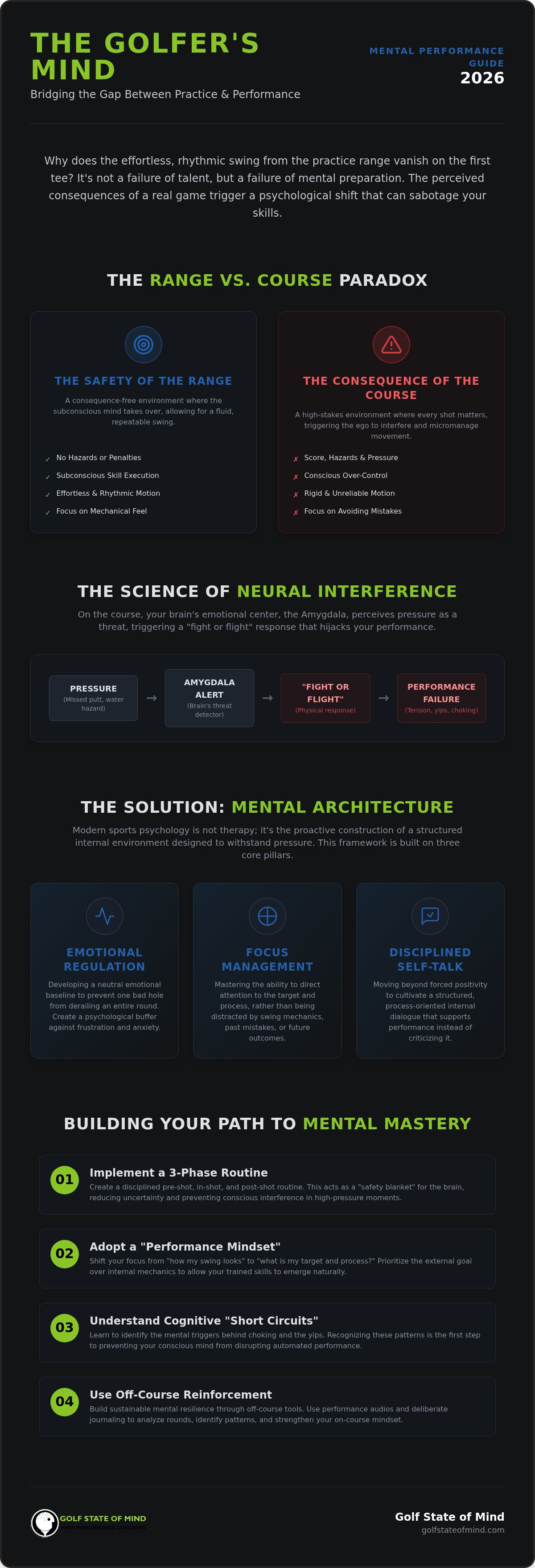
The Range vs. Course Paradox is the most pervasive frustration in the game. It describes the specific inability to transfer technical proficiency from the practice tee to the pressurized environment of a competitive round. While your swing feels fluid and effortless during practice, it often becomes rigid and unreliable when a score is on the line. This isn’t a mechanical failure. It’s a psychological one. The field of Sport psychology identifies this as a failure of skill transfer, where the brain’s processing changes based on the perceived stakes.
On the range, you enjoy the “Safety of the Range.” There are no hazards, no out-of-bounds, and always another ball to hit. This lack of consequence allows your subconscious to take over. On the course, the “Consequence of the Course” takes hold. Every shot matters. This shift triggers the ego to engage in technical over-control. You begin to micromanage your movements, trying to “steer” the ball. Traditional swing lessons often fail here because they address the physical motion rather than the mental interference that disrupts it.
The Science of Neural Interference in Golf
Most players engage in “Block Practice,” hitting the same club to the same target repeatedly. This creates a false sense of security; your brain isn’t actually learning to play golf, it’s just getting into a temporary rhythm. When you step onto the first tee, the Amygdala, the brain’s emotional center, perceives the pressure as a physical threat. It triggers a “fight or flight” response. Your brain treats a missed green or a potential three-putt like a predator in the woods. This neurological hijack is why sports psychology for golfers is essential for 2026 performance. It provides the tools to quiet the alarm and maintain cognitive clarity.
Moving Beyond the ‘Swing Fix’ Mentality
Stop looking for a mechanical solution to a mental problem. Transitioning to a “Performance Mindset” means prioritizing the target and your routine over the positions of your swing. You must accept that your range swing and your course swing will feel fundamentally different. One is born in a vacuum; the other is forged in reality. Recognize that your mind is the most important club in your bag. If you’re ready to build a structured approach to this transition, The Ultimate Mental Game Training System provides the methodical framework needed to move from technical awareness to true mental mastery. By shifting your focus from “how it looks” to “how you process,” you bridge the gap that technical drills alone can never close.
What is Sports Psychology for Golfers? Defining the Mental Architect
Many players view sports psychology as a form of “performance therapy,” something reserved for those suffering from a crisis of confidence or the yips. This perspective is limited. True sports psychology for golfers is better defined as mental architecture. It is the proactive construction of a structured internal environment that supports your physical skills. Just as an architect designs a building to withstand external pressure, a mental performance coach helps you build a mindset that prevents your swing from crumbling when the stakes rise. This system relies on three core pillars: emotional regulation, focus management, and disciplined self-talk. In the broader context of personal growth, speakers like Jeff Yalden emphasize that mental resilience often begins with a foundation of acceptance and emotional clarity.
David MacKenzie’s approach to the mental game differs significantly from the common “cheerleader” style found in some coaching circles. Rather than offering empty platitudes or forced positivity, he acts as a relatable guide who values process over immediate results. By focusing on the “Mental Architect” persona, you learn to treat your mind as a tool that requires specific, repeatable maintenance. This disciplined preparation ensures that your cognitive processes don’t interfere with the automated movements you’ve spent years honing on the practice tee.
In most athletic endeavors, “trying harder” is the path to success. In golf, increased effort usually leads to tension, which is the enemy of a fluid swing. Developing a stoic register is essential for maintaining a neutral emotional baseline. When you learn Mastering Golf Emotional Control, you create a psychological buffer. This buffer prevents a single bad hole from spiraling into a ruined round. You don’t need to be happy after a double bogey; you simply need to be neutral enough to execute the next shot with clarity.
The Role of the Subconscious in Elite Performance
Your subconscious mind is responsible for the complex, high-speed movements of the golf swing. The “Internal Critic” is the conscious voice that tries to micromanage those movements during the five seconds of the shot. Elite performance requires you to quiet this critic and trust your training. By inviting a “Flow State,” you allow your body to perform without the interference of over-analysis. If you’re looking for a methodical way to build this trust, The Ultimate Mental Game Training System provides the building blocks for a prepared and quiet mind. This transition from conscious control to subconscious execution is the hallmark of a true mental architect.
The 3 Phases of the Mental Game: Routine as Discipline
To the uninitiated, a routine is merely a sequence of physical movements like a waggle or a specific number of looks at the target. However, in the context of sports psychology for golfers, a routine is a psychological safety blanket. It exists to reduce uncertainty and provide the brain with a sense of control in an environment where variables like wind, lies, and score are unpredictable. The “Total Round System” moves beyond the pre-shot routine to encompass three distinct phases: the pre-shot, the post-shot, and the time between shots. Mastering this cycle ensures that you aren’t just playing golf, but managing your cognitive energy over 18 holes.
A disciplined routine requires a clear distinction between physical habits and mental intentions. While your physical routine might remain consistent, your mental routine involves active commitment. This process culminates in the “Commitment Signal.” This is your internal point of no return. Once you give the signal, you stop being a critic and start being a performer. This transition is vital for protecting your swing from the technical over-control discussed in earlier sections.
Phase 1: The Pre-Shot Commitment
Your brain processes information differently depending on your dominant cognitive style. Some players find success through Golf Visualization Techniques, seeing the ball’s flight in vivid detail. Others prefer verbalization, using internal cues like “smooth tempo” or “commit to the target.” To implement this effectively, use the “Box Method.” Establish a “Thinking Zone” behind the ball where you analyze the wind and lie. Once you step into the “Hitting Zone,” you leave the analysis behind and focus solely on execution.
Phase 2: The Post-Shot Reaction
Your round often crumbles because of how you react to a single mistake. Use the “10-Yard Rule” to manage your post-shot emotions. You’re allowed to feel frustration for exactly ten yards after hitting a shot. Once you cross that invisible line, the shot is over. Neutralize your internal critic by replacing emotional judgments with objective analysis. Instead of saying, “I’m a terrible putter,” state the fact: “I pushed that putt two inches right.” This keeps your emotional baseline neutral and ready for the next challenge.
Phase 3: Between-Shot Energy Management
Mental fatigue is a primary reason for back-nine collapses. You cannot stay intensely focused for four hours. You must learn to use focus “on/off” switches. When you aren’t hitting, turn your golf brain off. Talk to your playing partners or enjoy the scenery. As you approach your ball, use Golf Breathing Techniques to lower your heart rate and signal to your nervous system that it’s time to re-engage. This art of being present prevents your mind from drifting toward your score, keeping you anchored in the current moment.
Overcoming Common Mental Blocks: Yips, Choking, and Pressure
Mental blocks are not signs of a lack of talent; they are manifestations of a mind that has temporarily lost its architectural integrity. In the field of sports psychology for golfers, we identify these hurdles as specific cognitive disruptions that occur when the conscious mind interferes with the body’s natural ability to perform. Whether it’s the sudden inability to pull the trigger or a collapse on the final holes, these issues stem from how you process stress and focus. Understanding the mechanics of these blocks is the first step toward dismantling them. This focus on natural, unforced performance is a concept that extends into other high-stakes fields; for instance, if you’re interested in applying this philosophy to your professional life, check out How to ‘Sell’ The Way People Buy!.
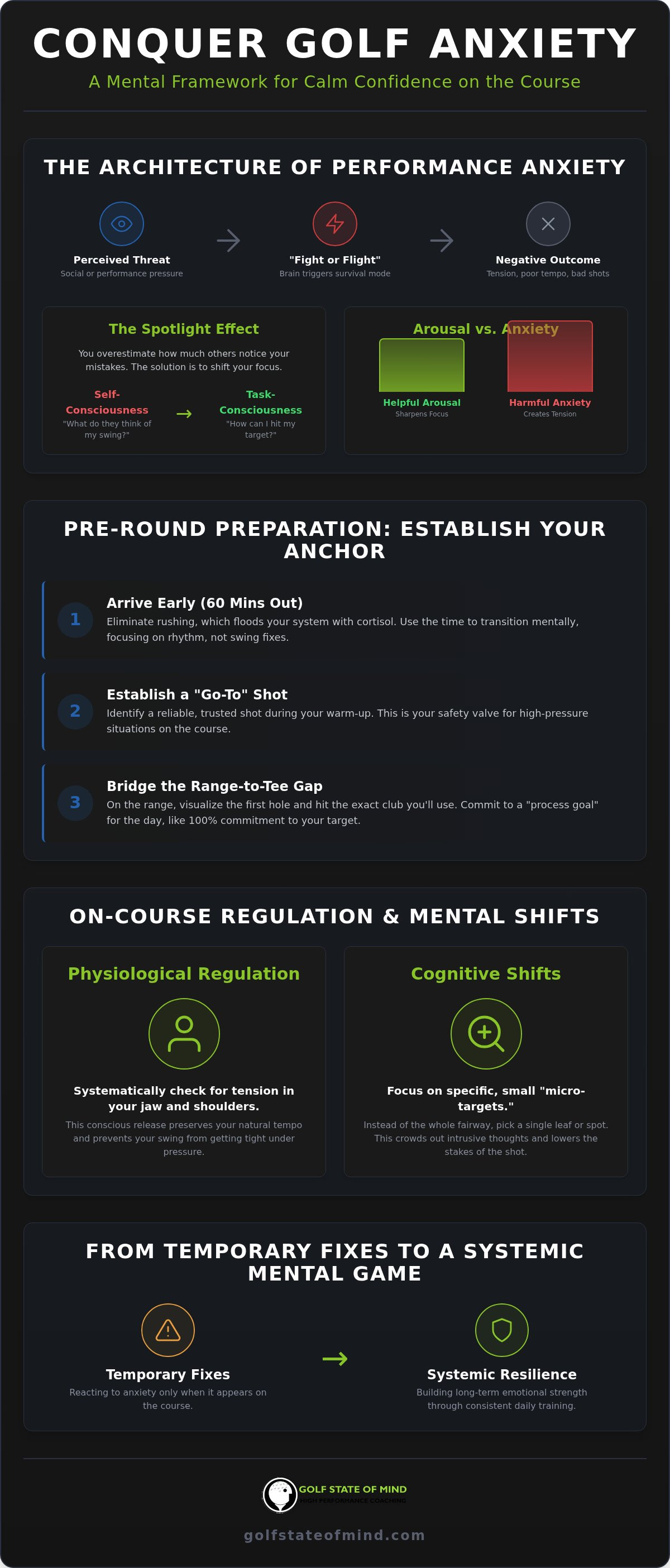
Choking is perhaps the most visible of these blocks. It occurs when the conscious mind attempts to take over an automated task. You’ve hit thousands of shots in your life, yet under pressure, your brain tries to “help” by micromanaging the mechanics. This shift from subconscious execution to conscious control creates tension and disrupts the fluid timing required for a successful swing. Similarly, first tee nerves are often mismanaged. Instead of trying to suppress the anxiety, you should reframe it as “readiness.” The physiological symptoms of nerves and excitement are identical; the difference lies entirely in your mental label.
The Psychology of the Yips
The yips are frequently misunderstood as a physical twitch or a neurological disorder, but they are more accurately described as a psychological short circuit. It’s telling that the yips usually appear on the shortest, “easiest” shots where the perceived consequence of missing is highest. This creates an intense internal focus on hand position or grip pressure. To reclaim your game, you must shift toward an external focus on the target. A structured Golf Yips Cure involves retraining the brain to prioritize intention over mechanics, allowing the subconscious to regain control of the movement.
Handling High-Pressure Moments
Scoreboard pressure ruins many promising rounds because it pulls your focus away from the present and into a hypothetical future. When the lead is on the line, the “One Shot at a Time” philosophy becomes your most valuable asset. Learning How to Handle Pressure in Golf requires a shift from outcome goals (the score) to process goals (your routine). If you can commit 100% to your pre-shot routine, you have succeeded, regardless of where the ball lands. This focus on the process acts as a shield against the weight of expectation. To systematically dismantle these barriers and reclaim your game, invest in The Ultimate Mental Game Training System, which provides the methodical framework needed to maintain composure when it matters most.
Building Your Personal Mental Training System
Mastery of the mental game is a deliberate construction project, not a fortunate accident. Transitioning from simple mental awareness to true mental mastery requires a structured system that operates both on and off the course. While understanding the theory of sports psychology for golfers is a necessary first step, real progress happens through the consistent application of off-course training tools. This includes the disciplined use of performance audios, deliberate journaling, and targeted meditation to reinforce your psychological architecture. It turns theory into results.
Digital tools have become essential for the modern practitioner in 2026. Utilizing a Mental Coaching App for Golfers allows you to track your emotional stability and routine consistency over time, providing data-driven insights into your performance trends. By integrating the Ultimate Mental Game Training System into your weekly schedule, you ensure that your mental skills receive the same focused attention as your ball striking. This methodical approach transforms abstract concepts into repeatable habits.
The 30-Minute Pre-Round Reset
Most golfers spend their entire warm-up on the practice range, focusing exclusively on physical mechanics. This approach ignores the reality that your mind needs to be as loose and prepared as your muscles. Your pre-round routine should be a 50/50 split between physical loosening and mental priming. This is non-negotiable. To assist with this mental priming, visit Nootropics Today to discover how their nootropic gummies can help sharpen your focus before you even reach the first tee. Use audio guides during the 30 minutes before your tee time to anchor your nervous system in a state of calm confidence. Before you leave the locker room, set a clear “Intention for the Day” that focuses on process and routine rather than a specific score.
The Case for 1-on-1 Mental Coaching
Digital systems provide a powerful foundation, yet personalized mentorship is often required to identify the specific blind spots in your mental architecture. A mental performance coach can see the subtle patterns of interference that you might miss yourself. This personalized feedback is particularly effective for accelerating the range-to-course transition, helping you apply theoretical principles to the unique pressures of your competitive environment. If you’re ready to move beyond self-study and build a truly resilient mindset, Book a free 15-minute consultation with David MacKenzie to start your journey toward sustainable progress.
Mastering the Architecture of Your Performance
Bridging the gap between a flawless range session and the pressure of the first tee requires more than just physical repetition; it demands a shift in your mental framework. By mastering the three phases of the round and neutralizing the internal critic, you transform from a technical student into a performance architect. This disciplined approach to sports psychology for golfers ensures that your swing remains resilient even when the stakes are high. You’ve learned that routine is a safety blanket and that pressure is simply a signal of readiness.
You don’t have to navigate this journey alone. David MacKenzie has developed a methodology focused exclusively on psychological performance, a system already trusted by NCAA champions and Tour Professionals. It’s time to stop letting one bad hole define your round and start playing with the quiet strength of a prepared mind. Your potential is already there. Now, give yourself the system to unlock it.
Master Your Mental Game with The Ultimate Training System
Frequently Asked Questions
What is the difference between a sports psychologist and a mental game coach?
A sports psychologist often holds a clinical degree and may address broader mental health issues alongside performance. For those seeking specialized support in this area, you can discover Women’s Mental Health Specialist and their hormone-informed approach to wellness. A mental performance coach, like David MacKenzie, focuses specifically on the “Mental Architect” approach, building structured systems for on-course execution. While both aim to improve results, a coach typically prioritizes the practical application of sports psychology for golfers, emphasizing routine and emotional resilience over clinical diagnosis or therapy-based models.
This professional distinction highlights the need for specialized guidance in any practice; for therapists looking to build their own successful businesses, Martin Hogg Private Practice Success offers dedicated coaching and accredited training.
You can significantly lower your scores by improving your decision-making and emotional stability. Most amateur golfers possess a “range swing” that is better than their current handicap suggests. By mastering the psychological architecture of the game, you reduce the mental interference that causes poor shots. This allows your existing physical skills to surface more consistently, leading to lower scores without the need for a single mechanical swing adjustment.
How long does it take to see results from mental game training?
You can experience immediate shifts in your composure and enjoyment during your very next round. However, building a truly resilient mental system is a cumulative process that typically takes four to six weeks of deliberate practice. Like any skill, mental mastery requires repetition. Just as Make Disciples offers a specialized mobile application to facilitate spiritual growth and ministry training, consistently using tools like performance audios and pre-round boosters ensures your “mental floor” rises, making your bad rounds much better than they used to be.
Is the ‘yips’ a physical or a mental problem?
The yips are fundamentally a psychological “short circuit” rather than a physical ailment. While the manifestation is a physical twitch or jerk, the root cause is the conscious mind trying to micromanage an automated movement under perceived pressure. Shifting your focus from internal mechanics to an external target is the key to recovery. By retraining the brain to trust the subconscious, you can dismantle the anxiety loop that triggers the physical involuntary movement.
How do I stop overthinking my swing while I’m standing over the ball?
Implement the “Box Method” to separate your thinking from your doing. Do all your analysis, such as checking wind and yardage, in the “Thinking Zone” behind the ball. Once you step into the “Hitting Zone,” commit to a single external target or a simple rhythmic cue. Give yourself a clear “Commitment Signal” to indicate that the time for thinking has ended and the time for athletic execution has begun.
What should I do if I lose my temper after a bad shot?
Use the “10-Yard Rule” to contain your frustration within a specific physical boundary. Allow yourself to feel the anger for exactly ten yards as you walk away from the shot. Once you cross that line, consciously drop the emotion and return to a neutral, stoic register. Neutralizing your reaction prevents the “emotional bleed” that often leads to a string of bogeys, protecting your focus for the next challenge.
Are there specific mental drills I can do on the driving range?
Replace “Block Practice” with “Random Practice” to simulate the pressure of the course. Never hit the same club to the same target twice in a row. Instead, play a “virtual round” where you visualize a specific hole and go through your full pre-shot routine for every shot. This incorporates contextual interference, which is a core principle in sports psychology for golfers, ensuring your range sessions translate to lower scores.
How do I stay focused for a full 4-hour round of golf?
You must utilize “on/off” switches to manage your cognitive energy. It’s impossible to maintain intense focus for four hours straight without suffering mental fatigue. Be intensely “on” during your pre-shot routine and the execution of the shot. Once the ball is in the air, turn your focus “off” by engaging with your surroundings or chatting with partners. This deliberate pacing preserves your mental stamina for the critical final holes.
Get your FREE Mental Game Scorecard
















 English (US) ·
  French (CA) ·