

 3 days ago
3
3 days ago
3
PROTECT YOUR DNA WITH QUANTUM TECHNOLOGY
Orgo-Life the new way to the future Advertising by Adpathway Brad Penner-Imagn Images
Welcome to Mathemadage, a new series where I investigate time-honored baseball adages using whatever data I can get my hands on and explore whether there’s any validity to them. I’ll apply my normal Ben Clemens mixture of a bit of math, a bit of intuition, and plenty of healthy doubt in declaring strong solutions to complicated problems. I hope to demonstrate that some of these true and others false, but I’m sure that many will end up in a suggestive but unprovable middle ground. And true to the premise of the series, we’re starting off with a fun adage that resists easy conclusions.
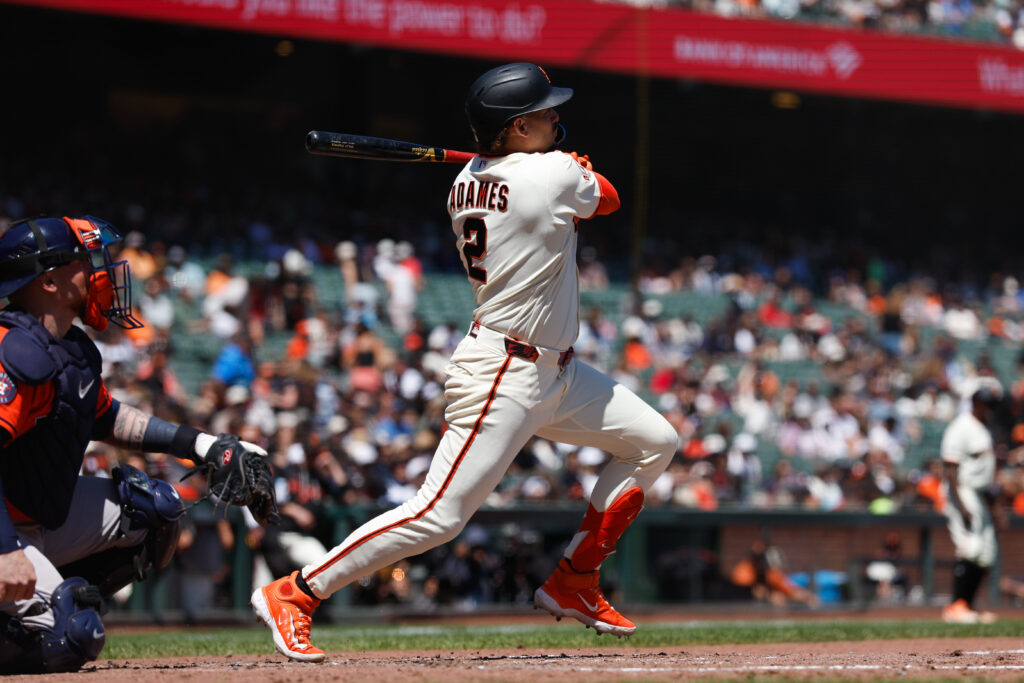
If you watch a baseball game from start to finish, you’re pretty much guaranteed to see a hitter get tied up on an inside fastball. “Got jammed,” the announcer might say, or maybe, “He just couldn’t get around on that one.” It’s a visual reminder of one of the pitching truisms that I learned as a kid and haven’t forgotten since: hard in, soft away.
I intuitively look for this pitching pattern when I’m watching a game. Hitters look incredibly uncomfortable when they’re trying to get their bat around a fastball in on their hands. Now that we have a few years of bat tracking data, though, I can do better than just vaguely searching for this effect. So this week, when I saw someone get jammed, I winced in sympathy and then started furiously downloading spreadsheets.
I had a theory: Fastballs are effective inside because fastballs are fast. To measure this, I took advantage of contact point relative to a batter’s center of mass, a new-ish Statcast metric. Every batter has different timing, of course, but by gathering all of the data for a given hitter, you can figure out their “normal” contact point. That lets you measure whether someone is early or late to the ball; if they’re ahead of their normal contact point, they’re early, and vice versa.
Well, kind of. You have to do some adjusting, of course. Batters don’t take the same swing at every pitch. “On time” doesn’t mean the same thing in every location. So I took the data and sliced it up, controlling for pitch location and count to get an idea of where a swing can be considered on time in various locations. This let me start to explore two key questions: How much does it cost to be late on an inside fastball, and how much does it cost to be late on an outside one?
I started by limiting my data to just fastballs and splitting the plate in three. I picked eight inch wide strips, so that “middle” means four inches on either side of the center of the plate, “inside” is between four inches and a foot towards a given batter from the center, and “outside” is four to 12 inches away from the center of the plate. I used all swings, whether or not the hitter made contact, to calculate where “on time” was for each hitter, separated by year to avoid aging effects. Then I graphed wOBACON based on where hitters make contact with the ball relative to expectations:
You Aren't a FanGraphs Member
It looks like you aren't yet a FanGraphs Member (or aren't logged in). We aren't mad, just disappointed.
We get it. You want to read this article. But before we let you get back to it, we'd like to point out a few of the good reasons why you should become a Member.
1. Ad Free viewing! We won't bug you with this ad, or any other.
2. Unlimited articles! Non-Members only get to read 10 free articles a month. Members never get cut off.
3. Dark mode and Classic mode!
4. Custom player page dashboards! Choose the player cards you want, in the order you want them.
5. One-click data exports! Export our projections and leaderboards for your personal projects.
6. Remove the photos on the home page! (Honestly, this doesn't sound so great to us, but some people wanted it, and we like to give our Members what they want.)
7. Even more Steamer projections! We have handedness, percentile, and context neutral projections available for Members only.
8. Get FanGraphs Walk-Off, a customized year end review! Find out exactly how you used FanGraphs this year, and how that compares to other Members. Don't be a victim of FOMO.
9. A weekly mailbag column, exclusively for Members.
10. Help support FanGraphs and our entire staff! Our Members provide us with critical resources to improve the site and deliver new features!
We hope you'll consider a Membership today, for yourself or as a gift! And we realize this has been an awfully long sales pitch, so we've also removed all the other ads in this article. We didn't want to overdo it.

What does this mean? The easiest way for me to think about it is that on inside pitches, there’s a big slope in play. The earlier you get to the ball, the more damage you do. There’s plenty of jaggedness in all of these lines, but if you fit a regression line to these slopes, every inch forward that a batter contacts the ball is worth about four points of wOBA on the inner third. In the middle of the plate, there’s very little slope; for every inch further out in front, wOBACON drops by 1.5 points. On the outer third, the slope is extremely negative; every inch forward costs batters six points of wOBA.
That’s the argument for inside fastballs in a nutshell. Fastballs in general create deeper contact points. They’re moving faster, after all, which gives hitters less time to react. Being late is bad on inside fastballs, but it’s relatively good on middle and outside fastballs. In other words, getting inside on hitters with your fastball lowers their production on contact.
It’s not quite that simple, of course. I’m measuring all of this relative to what I’m estimating is normal for each hitter, but that’s not really knowable. What’s more, expectations are almost impossible to account for this way. There’s so much game theory to an inside fastball. If a hitter thinks it’s coming, he can speed up, and look at the incredible value added by getting in front of an inside pitch. This data isn’t the whole answer, but there seems to be something there. Meanwhile, breaking balls don’t follow the same pattern at all:

There’s your first sign that there’s something here. Fastballs have meaningful early/late splits when it comes to damage on contact, while secondary pitches don’t display the same tendencies. At a basic level, the inside of the plate is where making batters swing late on fastballs pays dividends, and luckily, fastballs tend to produce late swings.
Of course, balls in play don’t tell the entire story; in fact, they often mislead. Luckily, Statcast also measures estimated contact points for swings that don’t hit the ball. That sounds weird, but you can think of them as where the swing and the ball cross planes, even if they don’t make contact. So if you swing under the ball, there’s still a “contact point” where your path and the ball’s cross. There’s some valuable information to be gleaned from this chart:

If you’re late to a fastball, you’re far more likely to miss, regardless of where it’s located. That makes sense to me just from a physical standpoint. Late, deep contact is associated with starting your swing late, or the classic theory of “time yourself for their secondary and speed up to hit the fastball if necessary,” or even just generally not expecting a hard pitch and getting your bat into the hitting zone slower than you’d like. And there’s a good flip side to the intuition; early swings, ones with contact points in front of average, produce more whiffs on secondary pitches:

If you squint, you could call those curves U-shaped, but the key signal is on the right side of the chart. Again, this all makes logical sense: Hitters miss by being early against secondary pitches or late against fastballs. Even if you never saw this data, I’m confident that you’d be able to guess the direction of these lines fairly easily.
So did we just prove “hard in, soft away?” Well, not really, as it turns out. I do feel comfortable saying a few broad things about pitches. Fastballs produce later (deeper) contact points in general. Later contact points suppress production on contact on inside fastballs to a large degree, but that relationship doesn’t hold over the middle of the plate or away. This just makes good logical sense. Imagine a hitter poking a fastball the other way on a pitch that they have to lunge outside for. Now imagine them trying to do that against a pitch on the inside of the plate. Late contact outside is often what hitters want to do; inside, it never is.
But there’s a large countervailing effect that completely cancels out that contact advantage. Let’s look at the whiff-per-swing graph for fastballs again:
Yes, late swings are more likely to miss regardless of where the ball is located, but outside fastballs produce more whiffs per swing across the board. If you’re very late to an outside pitch, you might punch it the other way, but you’re also extremely likely to miss it entirely. In fact, outside fastballs put the hitter in more of a bind than inside fastballs. What’s the right thing to do against an inside fastball? Get the bat head out! It makes you less likely to whiff, and also more likely to do damage. But what are you supposed to do against an outside fastball? Well, stay back, of course, but not too far back. Here’s the run value per 100 swings in the same type of chart. This combines whiff-per-swing, production on contact, and the cost of foul balls, and lower numbers are better for the pitcher:

The same graph for secondary pitches is a bit less cut and dried:

If batters are able to stay back on inside and middle secondaries, they can produce good results. But almost regardless of batter timing, locating secondary pitches away produces better results. That’s because batters do meaningfully less damage on soft pitches away. In my head, that’s just a physical phenomenon; batters like to take outside pitches the other way, and it’s harder to leave the park when you’re hitting the other way. On the other hand, it’s easy to conjure up a mental image of a hitter catching a hanging breaking ball and pulling it into the seats. Meanwhile, the misses mostly come out front, and no location has an obvious advantage in producing whiffs. Thus, the on-contact advantage of “soft away” makes it look like the best option for non-fastballs in the data.
If you used these charts to produce a conclusion, it’d be “hard away, soft away.” Inside fastballs might look like a good option because they suppress damage on contact, but the problem is that throwing them gives the hitter a good solution. Getting the bat started early decreases whiff rate and increases damage on contact. Outside fastballs don’t make it so easy on the batter; being late means plenty of chance at whiffing entirely, but being early increases your chances of rolling over the ball and lowers your expected damage on contact.
But even these conclusions aren’t all that robust. Hitter expectations have a huge role to play in this. What they’re looking for goes a long way towards determining the timing and shape of their swing, and that’s not a variable that we can access here. Maybe some of the value of a fastball away comes because many fastballs are inside. If hitting is timing and pitching is upsetting timing, there can’t be a single solution, because varying the looks that a batter sees is more important than showing them any one look.
That said, I still think this data supports the concept of “hard in, soft away” on balance, particularly to same-handed hitters. The strong signal in the data is that breaking balls away are valuable. Inside fastballs tunnel off of outside breaking balls thanks to the way each pitch breaks. Against opposite-handed hitters, there’s a natural pairing between fastballs away and changeups away, so maybe that’s the best option there. This data doesn’t exist independently of the usual cat-and-mouse games involved in the batter-pitcher confrontation, so it’s best to think of it in conjunction with how a pitcher’s arsenal fits together, rather than considering location on its own.
That feels like a good stopping point for the inaugural Mathemadage. As will often be the case, the truth is a lot more complicated than a pithy four-word saying. The truth is fascinating, though! And plenty of confounding variables can render even these conclusions less useful. For example, slow fastballs perform abysmally over the middle of the plate, but fast ones don’t. Batters might do more damage when they get to inside fastballs, but they also have a much larger variance in swings inside – more swings way behind and way ahead as they try to time things up while simultaneously pulling their hands in. Heck, the timing gap between where batters make contact with secondaries and fastballs is widest inside, even if that doesn’t produce the worst results, so there might be something to learn about how to exploit that gap in hitter ability.
I’m not sure what the final conclusion is, but at the very least, I’d say that “hard in, soft away” passes a fairly rigorous mathematical investigation. Oh, and please, give me more old sayings to explore. I can’t promise that I’ll write about any of them soon, but I plan on making this a recurring feature when I have some time to spare and a problem that I feel like applying a little bit of computer programming to.















 English (US) ·
  French (CA) ·