

In the past five years I’ve done 13 ocean passages. Each has been wildly different, and yet I’m struck with a sense of déja vu as we dock Jacqeau, our German Frers-designed 50-footer, for the last time in Fiji before setting off on the 1,300-mile journey south to New Zealand.
Cruising boats that have spent the past months forging their own paths though the wonders of the South Pacific gather in various set-off points between Tonga and New Caledonia. One such is Denarau Marina, Fiji, which is a hive of activity. Crews are scrambling to the chandlery for last minute hardware, weaving around trollies stacked with ample provisions for the trip ahead.
The air is thick with a familiar shared anticipation, every sailor here united by the same question: “When is the next weather window?”
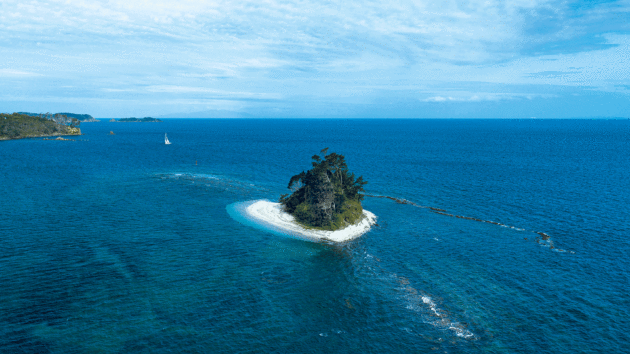
Photo: Josh McCormack, courtesy of projectworldsail.com
The anticipation is justified as the passage to New Zealand is said to be one of the toughest in the Pacific. For many ‘Milk Run’ sailors it’s the first time they’ll swap out the forgiving longitude crossing passages to instead head directly south and face the challenges that traversing latitude lines bring.
The suggested window is small, between mid-October and mid-November, threading a perilous needle between New Zealand’s winter and the South Pacific’s cyclone season. Leave too early and your chance of hitting a front below 30°S increases tenfold; too late and you risk getting swallowed up by a tropical depression.
This isn’t a case of checking out of a country and hoping for the best. Departure dates are carefully planned around navigating through low pressure systems and their associated fronts and troughs.
Most people start tracking the weather a month or more in advance, monitoring trends in the direction and speed that systems move through. The main objective? Meet the most severe of the weather before you reach 30°S – and for many this can mean heaving-to in the northern latitudes waiting for the worst to pass.
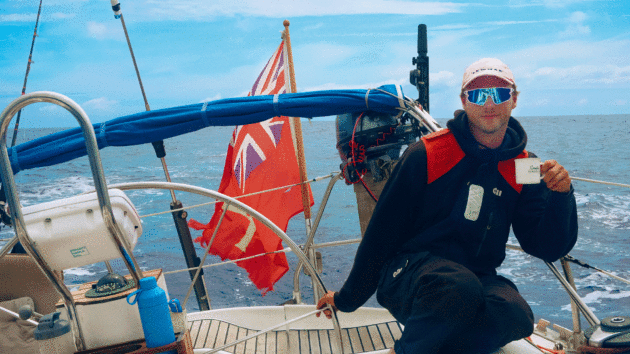
JP Baudains at the wheel. Photo: Charlotte DC & JP Baudains/projectworldsail.com
Mid-ocean pitstop
Our journey, however, starts by heading east when an opportunity presents itself to sail to Minerva Reef – an isolated atoll roughly a third of the way down to New Zealand. Not only does this break up the trip but allows us the chance to get more accurate forecasts as you get closer to the arrival date. This means a three-day upwind sail against the tradewinds.
For most cruisers this would be undesirable but thankfully we have light winds with a fair bit of north in them and these are the conditions that Jacqeau was designed for. Her narrow, flat bow pierces through the gentle swell, as the helm stays motionless – the lift between sails and keel balancing perfectly, allowing us to push forwards comfortably at 30° to the wind.
Exactly 72 hours later we encounter one of the most surreal moments we’ve ever had at sea. It is a clear day, with the blue tones of the water merging seamlessly into the sky, and there, floating in the middle of the Pacific Ocean, are dozens of boats at anchor. Each one taking shelter from the harsh trip down, waiting patiently in one of the most spectacular natural phenomena on the planet.

Jacqeau enjoys flat waters between Fiji and Minerva. Photo: Charlotte DC & JP Baudains/projectworldsail.com
Minerva Reef comprises two submerged atolls that originated as volcanoes. Over time these volcanoes eroded and the coral around the perimeters grew upwards. The result: an almost perfectly circular natural harbour that has been in the making for over a million years. The reef, unspoiled by human habitation, is luscious and teeming with life.
Fish swim past, uninterested in we visitors who share their home for just a few months of the year. JP leaps into action and manages to grab a couple of lobsters which we feast on for dinner.
Our plan was to enjoy Minerva for a few days, but the weather thought otherwise. Forecasts the following morning saw two mean-looking lows forming above Australia. Based on the trends we’d been seeing, if we didn’t leave today, we’d be stuck here for quite a long time. We weren’t the only ones with this idea as there was a frenzy of activity in the anchorage: it was time.
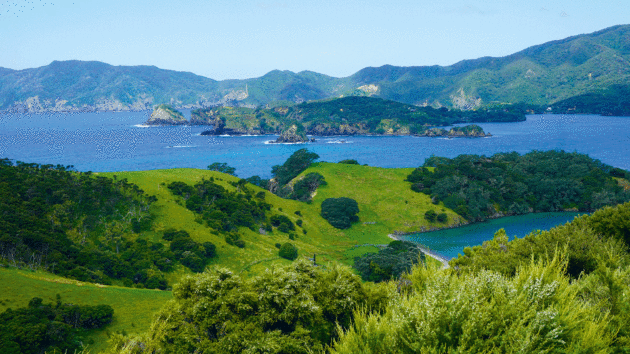
New Zealand’s Bay of Islands is a sailing paradise. Photo: Charlotte DC & JP Baudains/projectworldsail.com
Migrating tribe
Including us, there were 38 yachts in the reef when we arrived. The last viable window hadn’t been for a couple of weeks, and it showed. Exactly 24 hours after arriving, we exited the pass as part of a mass exodus, leaving just five yachts still at anchor.
The ‘fleet’ is made up of an assortment of monohulls and catamarans carrying nationalities from all over the world and forged together by a WhatsApp group to form a modern-day marine alliance.
Although it is water we’re crossing and not land, I can’t help but draw comparisons to the great travelling merchant caravans of the past. Both operate under the same principles – the importance of mutual protection, shared knowledge and recognising that the greatest danger lies in isolation.
While the messages that pop up on our phones are more instantaneous than the Wagon Masters’ bullhorns of the past, the core message remains the same: we are together, and we are safe.
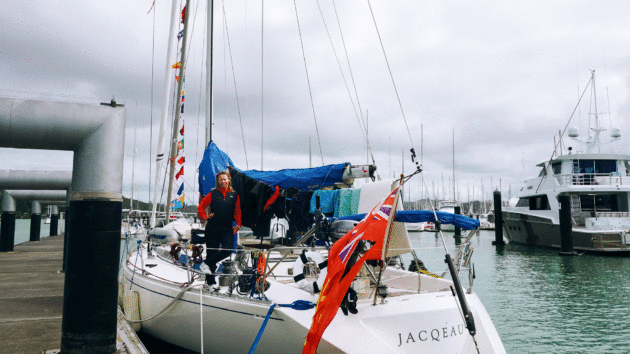
Drying out on the Opua quarantine dock. Photo: Charlotte DC & JP Baudains/projectworldsail.com
In broad terms, the navigation of this passage is split into three sections: a light first three days, followed by a horizontal band of unstable weather that turns abruptly into a strong easterly.
The crux lies in timing the crossing of a wide-spanning trough half-way through the passage. We’ve been tracking it for the past week and plan to time our approach to enter at first light and when it’s the thinnest. Why first light? If we keep our speed up we have an opportunity to traverse the worst of it in daylight, meaning less chance of lightning and the squalls packing less of a punch.
Article continues below…
It feels like a big deal to finally leave New Zealand’s shores, after all the hard work we’ve put into…
Patagonia isn’t a place you rush through. At least not if you want to experience it fully. Its fjords and…
Jumping the trough
Interestingly, we start off on a completely different track to the rest of the fleet, who all head south-west, bows pointing to New Zealand. Our choice is to head south-east, and although not great for our VMG, there is method in our madness. Not only does it get us into favourable current, but it aims us at a narrow point of the trough and allows us to take a more downwind point of sail when the wind does kick in.
The first two days, although light and unchallenging sailing, saw the gradual demise of our autohelm. After endless fixing attempts and diagnostics, we admitted defeat and declared death due to old age.
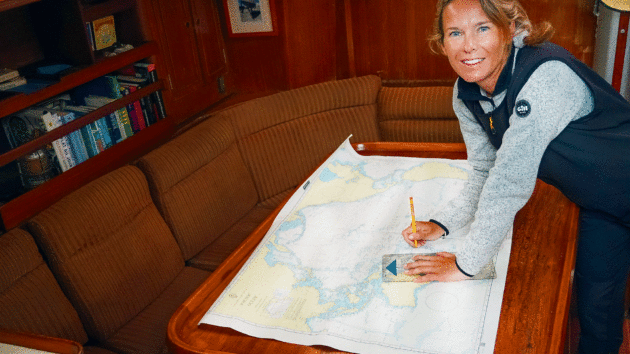
Charlotte DC helped run some of the UK’s biggest festivals before becoming a professional sailor. Photo: Charlotte DC & JP Baudains/projectworldsail.com
Furthermore, our chartplotter was struggling to find satellites out here in the remote Pacific Ocean. Stripped of our modern-day aids, we went back to basics and let the compass guide us by day.
By the time nautical twilight crept in the universe’s spectacular show commenced – the clear skies revealing a vast array of stars and constellations. Each night started with the demigod Maui’s famous fishhook (Ka Makau Nui o Māui, or Scorpius in Greek mythology) shining brightly from the west.
By the third evening the sky started to close in on us. At first the vast blue streaked with wispy, high white clouds that gradually got lower and thicker. We started to get some reports from the fleet who’d steamed ahead and chosen to enter the trough by nightfall – squalls of 26 knots on the bow, lots of rain but no reports of lightning. We motored onwards with anticipation.
As planned, we entered the trough at first light and what followed were 36 of the most draining hours we’ve ever had at sea. Conditions were grey and incredibly wet. With little to no wind we motored through the rain that slowly penetrated both us and the boat.
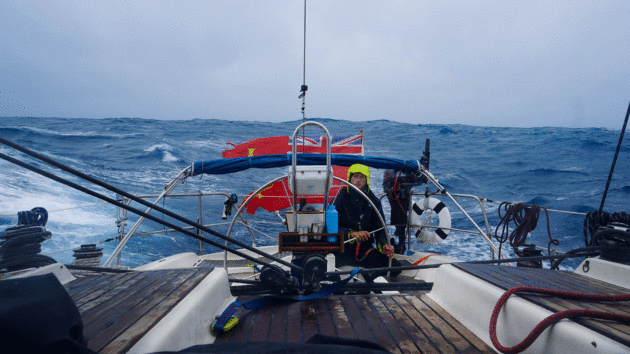
JP Baudains at Jacqeau’s wheel in grey, wet conditions heading south to New Zealand. Photo: Charlotte DC & JP Baudains/projectworldsail.com
The concentration that had been required to hand steer for three days began to take its toll on our energy levels. In the grey abyss with no reference points our focus would sometimes wane, causing the boat to meander on elaborate zigzags. But every second counted here if we wanted to get out the other side by nightfall so we shortened our watches to two hours – the maximum time we could hold our concentration.
We heeded warnings from boats up ahead of a horrible sea state leading up to the easterlies and, as the evening settled in, we entered it.
It was as if the different parts of surrounding ocean had sent us remnants of all their swells to fight it out. But without a breath of wind to settle it, restless chaos reigned, and a maelstrom of directionless water surged and fell from every angle. Our tired arms tried their best to keep the boat moving in the right direction as Jacqeau jerked, pitched and rolled through the lumpy undulating water – this was hell.
While one person helmed the other slept up on deck in what we call ‘The Cat’s Basket’, a small 1m2 dip in our companionway. With little protection from the elements, we covered ourselves in a waterproof blanket and tried (unsuccessfully) to get some rest.
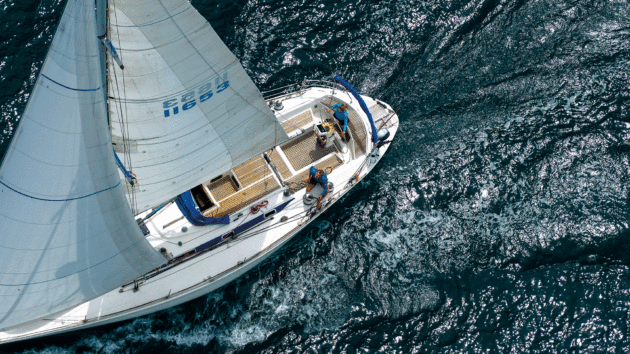
Jacqeau is a 50ft German Frers-designed Fast 500 that Charlotte and JP refurbished themselves with all new systems. Photo: Josh McCormack
We weren’t the only ones suffering here and the WhatsApp group was pinging regularly with messages from frustrated sailors who had renamed this ‘the suck zone’. Everyone was asking the same singular question: “WHEN WILL WE GET THE WIND?”. Reassurance started to dribble through from the lower latitude lines, bringing some relief. We weren’t going to be stuck like this forever.
But when we reached those latitude lines, nothing changed. The forecast had us entering the easterly wind by sunset and instead we’d spent a torturous night using every ounce of our concentration just to stay awake and keep moving.
By the time we checked the forecast again in the morning we saw an ever-growing wind hole had appeared with us at the centre. This really was never
going to end – and we were now running low on diesel.
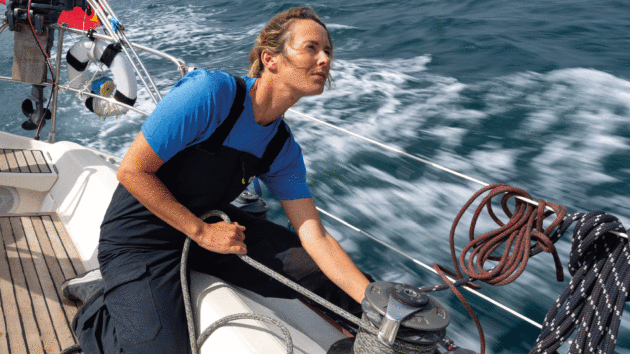
Charlotte DC has sailed tens of thousands of miles, and raced in many top regattas. Photo: Josh McCormack
Entering 30°S
When the wind eventually came, it came in hot. From 3 to 30 knots in the space of an hour, the sound of the engine replaced by the howling winds and boisterous seas. The 30°S parallel was living up to its reputation as we rode the intensified outer edge of a high pressure.
Although the isolated elements of the weather weren’t terrible, the sum of their parts made for some taxing conditions on board. Gusting 35 knots with a very short period swell caused waves to jack up and break with thunderous roars all around. Jacqeau surfed, climbed and weaved through the throngs of white water as we focused all our energy on keeping her going.
By 9am, however, the wild and confused ocean got the better of us as a rogue wave rose sharply up behind us.
We watched its face grow larger and larger, the realisation hitting fast that there was nowhere we could go to avoid it. Deep dark blues turned into angry loud white crests as the wave performed its final rear up, before crashing down to engulf us and cause Jacqeau to suffer a knock down.
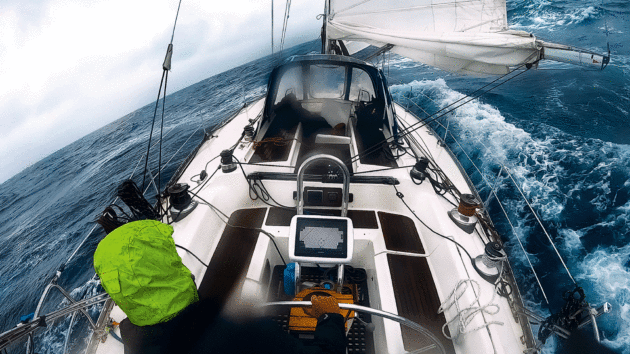
Conditions deteriorate as the couple head south. Photo: Charlotte DC & JP Baudains/projectworldsail.com
JP, luckily clipped on, quickly removed his hands from the helm and clung on to the high side of the pushpit as the wave raced through the cockpit, taking everything with it.
There was a loud clattering from down below as everything that had once lived on the port side of the boat went freefalling across the interior. The Starlink dish, which had been mounted on the leeward pushpit, was submerged and subsequently separated from the boat.
It all happened so quickly we didn’t really have time to compute what had just occurred. As Jacqeau righted herself, all our attention was on tackling the next wave set that came through. Perhaps that is one of the most character defining parts of offshore sailing – in tough conditions there simply isn’t time to do anything else aside from sail the weather in front of you.
Throughout the rest of the day we took turns to helm for as long as our arms could stand it. We’d barely slept for 48 hours, and both us and the boat were soaked through.
Our VHF radio was now our main form of communication and, luckily, we were still in range of fellow yacht Scout from the fleet. With the loss of our Starlink and the thick cloud cover we were struggling to receive satellite data, so we coordinated with Scout and used our paper charts to ensure a clear route to our destination.
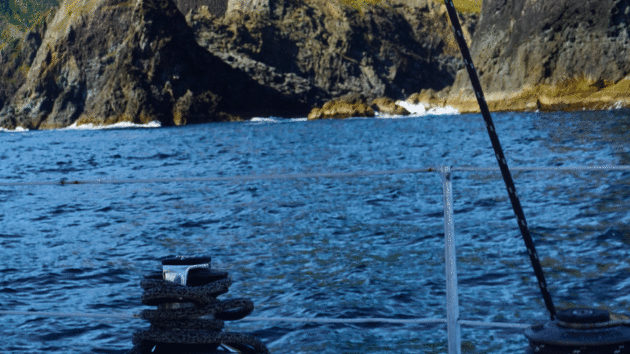
Cape Bret Lighthouse signifies the entry to the Bay of Islands. Photo: Charlotte DC & JP Baudains/projectworldsail.com
Passing boats with the luxury of accessing forecasting apps relayed weather updates through the crackle of the radio. They brought good news: from midnight the wind and the swell were slowly decreasing, it was all downhill from here.
By the time evening came, our arms had become extensions of the boat. A combination of instinct and muscle memory kicked in as the accumulated knowledge from the day before resulted in what, we had to admit, was some fantastic offshore sailing. And although we still ended each three-hour watch in an exhausted heap, the simple and pure joy of sailing kept us smiling as Jacqeau raced through the swell, hull humming.
Albatross welcome
As promised, by morning the wind had decreased enough to allow us to breathe air back into Jacqeau’s heavily reefed sails. And as if nature was signalling a safe passage onwards, we caught our first ever glance of the mystical albatross. Its broad and beautiful silhouette flirted gracefully with Jacqeau as it circled around us, effortlessly dipping in and out of the waves that we’d fought so hard to sail through.
Seeing this beautiful creature was a true symbol of how far we had come.
The Māori name for New Zealand is Aotearoa, translated as ‘Land of the Long White Cloud’ as ancient Polynesian navigators used to recognise their closeness to the islands from the long clouds surrounding it. Thousands of years later the name still rings true. After four days of non-stop rain we caught our first small glimpse of blue.
We arrived in the Bay of Islands, a sailing paradise of 144 sub-tropical landmasses cradled within its own natural harbour. As we cruised the flat water, we exchanged smiles and waves with local daysailors. Here, dark, jagged rocks shoot from the green depths, embracing luscious, sheep-spotted islands and deserted beaches. It’s an alien world in comparison to the reefs of Fiji and yet reminds me so much of home.
As the Q flag was raised, we shed the trials of the trip and instead felt only excitement at the beginning of a new chapter in our circumnavigation.
 If you enjoyed this….
Yachting World is the world’s leading magazine for bluewater cruisers and offshore sailors. Every month we have inspirational adventures and practical features to help you realise your sailing dreams.
Build your knowledge with a subscription delivered to your door. See our latest offers and save at least 30% off the cover price.
Note: We may earn a commission when you buy through links on our site, at no extra cost to you. This doesn’t affect our editorial independence.








 English (US) ·
  French (CA) ·