

PROTECT YOUR DNA WITH QUANTUM TECHNOLOGY
Orgo-Life the new way to the future Advertising by AdpathwayThat’s it. The story that began with the Enduro World Series in 2013 closes in 2026, 14 seasons on. Warner Bros. Discovery and the UCI are shutting down the Enduro World Cup. For professional enduro racing, it reads as a heavy blow. For the discipline itself, it might be the liberation enduro has been crying out for.
The news is official: 2026 was the final season of the UCI Enduro World Cup in its current format. From 2027, the Enduro and E-Enduro World Championships will remain as the sport’s major UCI stage, but the World Cup will disappear.
That removes the top tier of a pyramid that shaped an entire generation of racers: local race, national series, EWS or EDR, Factory Team. In 2027, for the first time since the Enduro World Series launched in 2013, there will be no full international enduro season under this umbrella.
It sounds like an ending. It isn’t. Enduro isn’t dead. What has failed is a system that kept forcing the sport into a framework it was never built to fit. Think back to the early EWS and the fascination its pioneers Enrico Guala, Fred Glo, Darren Kinnaird and Chris Ball built around it, and one thing comes into focus: enduro thrived because of its accessibility, its improvisation, its eye for detail, and everything that happened in the places and moments beyond the tape.


With professionalisation, the sport itself didn’t vanish, but more and more of its unpredictability did. EWS racing once ran on curiosity above all, on a sense of discovery and versatility, exactly as grassroots racing still does today. Every mountain biker could see themselves in it, could recognise the fun and curiosity at its core, which is why enduro racing drew professionals from every discipline.
Enduro Isn’t Just Worse Downhill
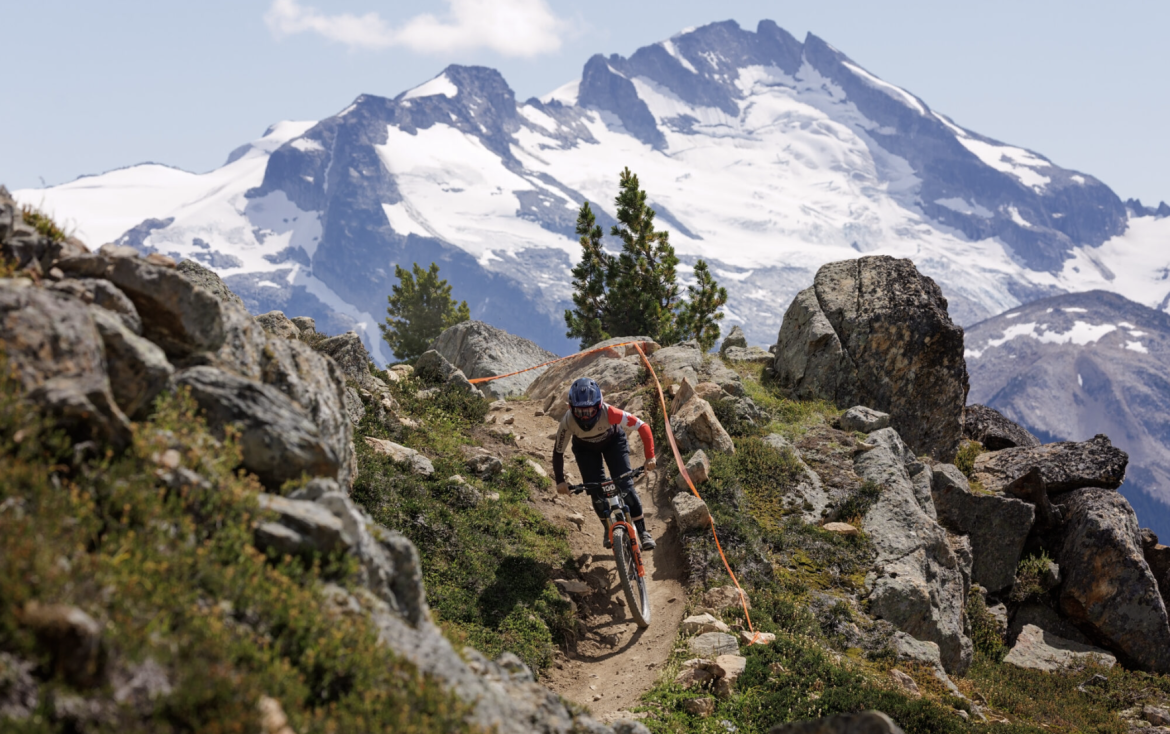
50 kilometres, several mountains, five, six or eight stages, race days that run for hours, and riders disappearing into the woods somewhere between two valleys. That’s exactly what makes enduro so exciting, and at the same time, pretty hopeless for a conventional TV sport.
Downhill tells itself: one rider, one track, one time. XCO gives you a circuit, a field and a winner. Enduro has 150 riders, six stages, three valleys and eight hours of racing. The fundamental mistake of recent years, then, wasn’t a lack of professionalism. It was trying to professionalise enduro according to the same rules as other World Cup disciplines.

The UCI improved things too, no question. Clear rules, safety standards, international recognition and, above all, a proper World Championship with a rainbow jersey are achievements that will endure. But an adventure was steadily becoming a product. And suddenly, that product had to work according to conventional sports marketing criteria: reach, broadcast, sponsor ROI, hospitality, standardised processes. That’s exactly where enduro began to lose its greatest strength.
The EWS Was Once a Search for the Best Mountain Biker in the World
Anyone who lived through the early years of the EWS remembers more than just the results. Rotorua. Madeira. Finale. Whistler. Zermatt. Chile. You wanted to know where the racing was happening, and what came with it, because every destination felt like a small adventure in its own right, bringing a different culture to the fore. The destination, the trails, the transfers, broken bikes, hero saves, transfer fails, the characters and the adventure weren’t side notes. They were the story.
Greg Callaghan sums it up pretty well in his reaction to the end of the EDR. For him, the corporate approach and enduro’s adventurous character had become increasingly difficult to reconcile over the past three years. So he doesn’t see WBD stepping aside purely as a loss, but also as an opportunity to bring the sport closer to its original values again. His reference point is the old EWS idea: “the search for the World’s best mountainbiker.”

That’s a crucial distinction. Not the perfect TV show. Not the cleanest sponsor wall. Finding out who’s the most complete mountain biker on unfamiliar trails, in changing conditions and over the course of an entire weekend. A little more adventure instead of neatly-taped race tracks. Maybe even a little more Camel Trophy spirit and self-reliance instead of huge team trucks.
The End Didn’t Come Out of Nowhere
Back in 2023, we already wrote about the massive problem facing professional enduro racing. Since then, the warning signs have only become harder to ignore.What was once a true world series, with races in New Zealand, Chile, North America and Europe, increasingly turned into a Central European affair. Factory teams disappeared, high-profile riders moved onto the downhill circus, privateers struggled with enormous costs, and media reach remained limited compared with DH and XC. In 2026, just five UCI Enduro Teams are registered.


On top of that, the bike industry is still under massive pressure when it comes to marketing budgets. By then, the problem had long since grown beyond a weak economy. The Enduro World Cup itself was becoming steadily harder to sell commercially, and even if the numbers were good according to the UCI and Warner Bros., one thing is easily forgotten: the bike industry thrives on things with soul. And if enduro racing tries to position itself with the same seriousness as DH or XC instead of finding its own path, it runs into trouble.
Professionalism doesn’t have to mean conformity, and the proof comes from an unlikely quarter: Bjorn Riley, one of the hottest names on the current XC circuit. A little like Peter Sagan, he pays scant attention to the unwritten rules, does his own thing and polarises people as a matter of course. That is exactly what makes him one of the most exciting characters in mountain biking. Sport doesn’t just need performance. It needs personalities. Enduro even more so. Enduro needed to become more professional. But never more normal.
And that’s exactly why there’s little point in simply calling for the next big player to come along, put a load of cash on the table and build EDR 2.0.
Crankworx Is Already Ready to Step In
Needless to say, a vacuum like this doesn’t stay empty for long. After the UCI and Warner Bros. Discovery announced the end, other organisers were already gearing up. First and foremost Crankworx, which announced a global enduro series for 2027 within 24 hours of the UCI news. The stated goal: a consistent international calendar built around what actually matters to riders, sponsors and destinations.
More interesting still is the language behind it. Crankworx talks about bringing enduro “back to its core”: fun, adventure, participation, the world’s best trails, open entry, community and strong bike destinations. The Canadian Open Enduro in Whistler is set to be part of the new series.
That sounds suspiciously like what made enduro great in the first place. And it shows that the end of the EDR doesn’t just leave a gap. It opens the market to better ideas. Now Crankworx has to prove that “back to its core” is more than good marketing. And give enduro the room to be enduro again.
More Camel Trophy, Less Perfect World
Breaking free of the corporate straitjacket is exactly where the big opportunity lies. Enduro doesn’t need another huge organisation trying to save the sport with maximum infrastructure. In a bike industry with tight budgets, an international enduro series has to be one thing above all: affordable. For organisers. For destinations. For teams. For brands. And above all, for riders.

A good enduro race doesn’t need huge factory paddocks, hospitality lounges or a multi-million-dollar live production. It needs great trails, reliable timing and a few hundred people who are up for spending a weekend racing together. And yes, maybe it also needs the courage to bring back a little more adventure, unpredictability and struggle. Not more rules, pressure and complexity – but more freedom, improvisation and room for the unexpected. Pro or amateur, racing should still feel like a weekend well spent: with time to explore, experience the local culture and actually enjoy the place you’ve travelled to. Give the event some room to breathe. The fastest riders will fight for every tenth anyway. Everyone else might just go home with a better story.

At its core, enduro isn’t a spectator sport. It’s a participant sport. The rider is customer, athlete and part of the show all at once: they pay to enter, travel to the destination, stay there, eat there, ride the trails and spend the weekend with people who love the same sport.
That’s why the finest enduro events were never sterile professional productions. They were festivals, where pros and amateurs rode the same trails, stood in the same lift queue and met up again later in the paddock. It’s precisely this closeness that sets enduro apart from almost every elite sport there is.


Earlier this year, I swapped my bike for two horses and, just seven months after my first riding lesson, took on the toughest horse race in the world: 10 self-supported days through Patagonia, across bogs, past glaciers and through a dark forest that could have served as a Lord of the Rings set. What does that have to do with enduro racing? In all the pressure to perform and the constant drive to optimise, we lose sight of the very reason we started in the first place: discovering new things and learning new skills. We try to eliminate every element of chance, when maybe we should start inviting it back in.
Enduro needs more uncertainty, more improvisation, more struggle. More situations where it’s not perfect support that counts, but your own solution. A little more Camel Trophy on two wheels. Because the best adventures and the best stories don’t happen when everything goes to plan. Today, too many people chase the fastest time instead of having the best time. A good enduro race shouldn’t just find out who rides fastest, but who copes best.

Enduro Needs to Belong to All of Us Again
One of enduro’s greatest strengths has always been the closeness between world-class racing and the amateur scene. Pros and amateurs ride similar trails, queue for the same lifts, meet in the paddock and drink the same beers once the race is over. So why give up exactly that?
The future should be less about closed-off World Cups and more about big enduro festivals: pro racing, amateur and kids’ races, ride-outs, bike tests, parties and community – all embedded in destinations that are worth the trip even without a race number. Not just a race, but a whole weekend where everyone can be part of enduro. That makes the sport more accessible and the event itself more relevant for riders, organisers, destinations and bike brands.


The Industry Needs to Rethink Things Too
Bike brands should ask themselves what they actually want to fund. Another truck? More hospitality? Another content crew trailing the Factory Team? Or races their customers can take part in themselves, events that offer more than just a race track? A complete experience where some things are essential, but plenty of others are simply there because they make the weekend better. The more we bring back the good times and camaraderie, the more people will want to be part of it.
A sports format doesn’t just have to be exciting. Its business model has to fit its DNA. And enduro has one decisive advantage: the participant is also the customer. Crankworx doesn’t need 50,000 people watching a livestream if 1,000 come to Whistler, race themselves and live enduro. Participation over reach at any cost.


€200,000 spread across ten strong grassroots events could do more for the future of enduro than putting the same amount into another factory race truck. Because if you want people to still be buying enduro bikes ten years from now, you need people today who know just how good it feels to ride enduro.
Strong local races. Good national series. A handful of iconic international events in places every enduro rider dreams of racing at least once in their life. Pros and amateurs at the same event. And above it all, a World Championship where the rainbow jersey remains the ultimate sporting prize. Not a bloated copy of the old system. An ecosystem that actually fits the sport.
Please, No EDR 2.0
For the people who make their living from the World Cup, its end is anything but good news. Jobs, Factory programmes and career paths are at stake. There’s no point romanticising that.
But there’s just as little point in keeping a system artificially alive simply because we’ve grown used to it. Enduro didn’t become big because of UCI points. Not because of TV reach. Not because of Factory trucks. It became big because a handful of visionaries managed to take the feeling of an incredible bike ride and put it on a global stage, turning it into an international race format – accessible, friendly and dreamily epic. That’s where the Spirit of Enduro came from.
If Crankworx or someone else can build an international series around that idea, bringing adventure, community, destination and racing back together, then in hindsight the end of the EDR might look less like a funeral and more like liberation.
Enduro needs a professional world series again. But not one that tries to look like a conventional World Cup. Professional enough for world-class racing. Wild enough for adventure, improvisation and the best stories. The UCI Enduro World Cup is dead. Now enduro has the chance to become enduro again.

Did you enjoy this article? If so, we would be stoked if you decide to support us with a monthly contribution. By becoming a supporter of ENDURO, you will help secure a sustainable future for high-quality mountain bike journalism. Click here to learn more.
Words: Robin Schmitt Photos: Sven Martin, Eliseo Miciu










 English (US) ·
  French (CA) ·