

 21 hours ago
1
21 hours ago
1
PROTECT YOUR DNA WITH QUANTUM TECHNOLOGY
Orgo-Life the new way to the future Advertising by Adpathway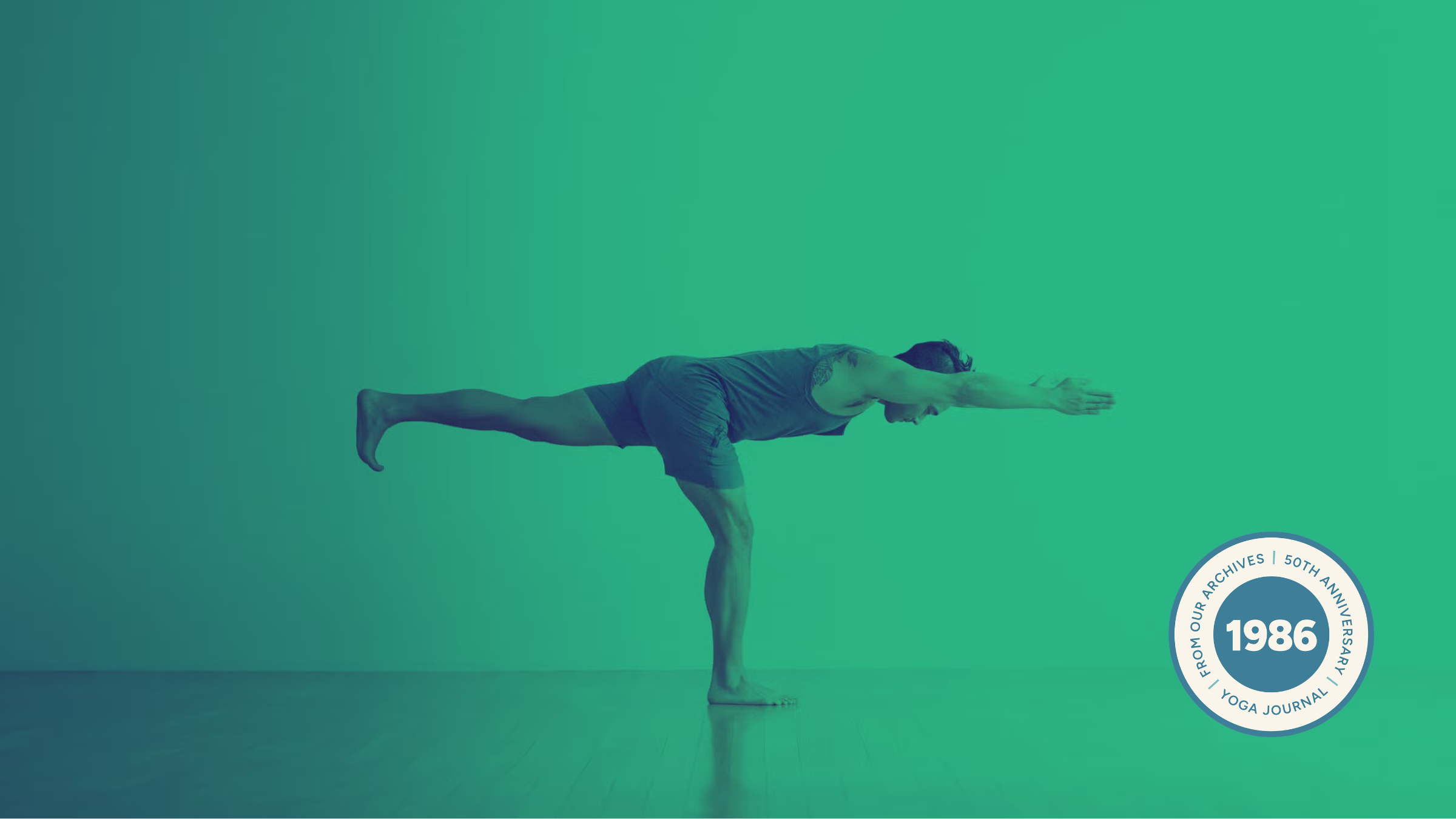
(Photo: Andrew Clark; Design in Canva)
Published August 24, 2026 11:02AM
Yoga Journal’s archives series is a curated collection of articles originally published in past issues beginning in 1975. This article about Warrior 3 Pose (Virabhadrasana III) first appeared in the January-February 1986 issue of Yoga Journal.
Warrior 3 Pose (Virabhadrasana III) requires balance, strength, and endurance as well as stretch in the muscles. Usually not given to very new students, this standing pose strengthens virtually all the muscles of the trunk, buttocks, and legs and many of the shoulder muscles also.
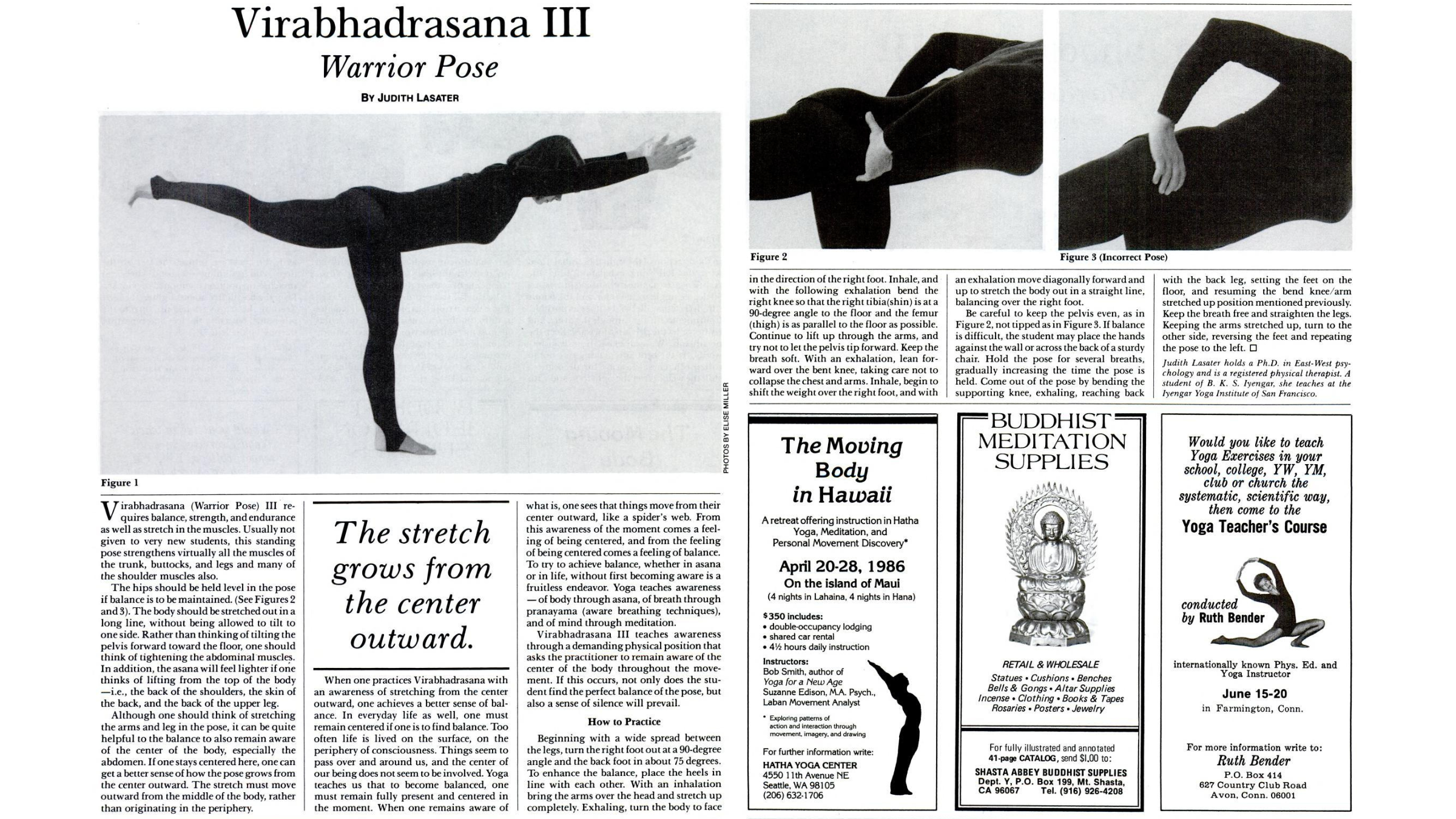 (Photo: Yoga Journal, 1986)
The hips should be held level in the pose if balance is to be maintained. (See Figures 2 and 3). The body should be stretched out in a long line, without being allowed to tilt to one side. Rather than thinking of tilting the pelvis forward toward the floor, one should think of tightening the abdominal muscles.
In addition, the asana will feel lighter if one thinks of lifting from the top of the body—i.e. the back of the shoulders, the skin of the back, and the back of the upper leg.
Although one should think of stretching the arms and leg in the pose, it can be quite helpful to the balance to also remain aware of the center of the body, especially the abdomen. If one stays centered here, one can get a better sense of how the pose grows from the center outward. The stretch must move outward from the middle of the body, rather than originating in the periphery.
When one practices Warrior 3 with an awareness of stretching from the center outward, one achieves a better sense of balance. In everyday life as well, one must remain centered if one is to find balance. Too often life is lived on the surface, on the periphery of consciousness. Things seem to pass over and around us, and the center of our being does not seem to be involved. Yoga teaches us that to become balanced, one must remain fully present and centered in the moment. When one remains aware of what is, one sees that things move from their center outward, like a spider’s web. From this awareness of the moment comes a feeling of being centered, and from the feeling of being centered comes a feeling of balance.
To try to achieve balance, whether in asana or in life, without first becoming aware is a fruitless endeavor. Yoga teaches awareness—of body through asana, of breath through pranayama (aware breathing techniques), and of mind through meditation.
Warrior 3 teaches awareness through a demanding physical position that asks the practitioner to remain aware of the center of the body throughout the movement. If this occurs, not only does the student find the perfect balance of the pose, but also a sense of silence will prevail.
How to Practice Warrior 3
Beginning with a wide spread between the legs, turn the right foot out at a 90-degree angle and the back foot in about 75 degrees. To enhance the balance, place the heels in line with each other. With an inhalation bring the arms over the head and stretch up completely. Exhaling, turn the body to face in the direction of the right foot. Inhale, and with the following exhalation bend the right knee so that the right tibia (shin) is at a 90-degree angle to the floor and the femur (thigh) is as parallel to the floor as possible.
Continue to lift up through the arms, and try not to let the pelvis tip forward. Keep the breath soft. With an exhalation, lean forward over the bent knee, taking care not to collapse the chest and arms. Inhale, begin to shift the weight over the right foot, and with an exhalation move diagonally forward and up to stretch the body out in a straight line, balancing over the right foot.
Be careful to keep the pelvis even, as in Figure 2, not tipped as in Figure 3. If balance is difficult, the student may place the hands against the wall or across the back of a sturdy chair. Hold the pose for several breaths, gradually increasing the time the pose is held. Come out of the pose by bending the supporting knee, exhaling, reaching back with the back leg, setting the feet on the floor, and resuming the bend knee/arm stretched up position mentioned previously. Keep the breath free and straighten the legs. Keeping the arms stretched up, turn to the other side, reversing the feet and repeating the pose to the left.










 English (US) ·
  French (CA) ·