

 1 day ago
3
1 day ago
3
PROTECT YOUR DNA WITH QUANTUM TECHNOLOGY
Orgo-Life the new way to the future Advertising by AdpathwayPublished September 18, 2026 11:13AM
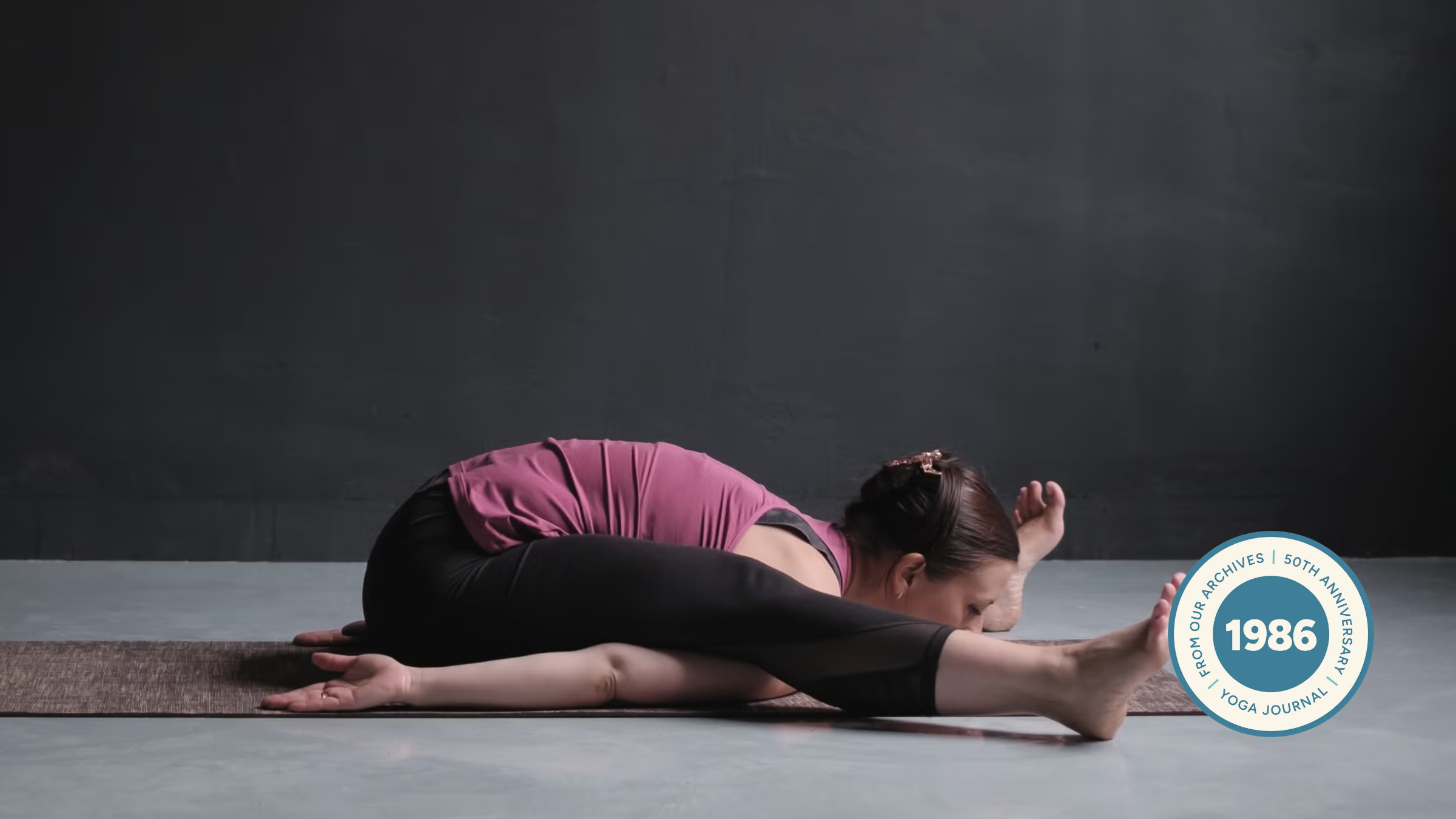
In Yoga Journal’s Archives series, we share a curated collection of articles originally published in past issues beginning in 1975. This article about Uttanasana (Standing Forward Bend) first appeared in the March-April 1988 issue of Yoga Journal. Find more of our Archives here.
Uttanasana (literally, “intense stretch pose”; Figure 1) is a cooling and quieting pose that gives an intense and deliberate stretch to the spine. It is frequently used between standing poses to quiet the mind and restore physical vitality. Uttanasana is also beneficial for persons “who feel heaviness in the head or discomfort when attempting the Headstand.”¹ When practiced before Headstand, Uttanasana will usually relieve this problem.
 (Photo: Yoga Journal, 1988)
Uttanasana is distinguished from forward bends performed in a sitting position in that gravity is a definite ally. Because Uttanasana uses gravity more effectively, it is less of a strain on the structures of the spinal column. The difficulty for the spine is not so much in the position itself, but in the going down into and coming up out of the pose.
As one goes down into Uttanasana, the posterior muscles (those on the back of the body, such as the spinal muscles, buttocks, and hamstrings) should lengthen slowly to allow the trunk to descend carefully, thus preventing it from falling forward too rapidly. In addition, one should remain attentive to avoid overly rounding or overarching the spine, both of which can cause undue strain. The position of least strain for the column, especially the lower back, or lumbar spine, is a gently arching curve — and one of the biggest challenges of Uttanasana is to maintain that gentle curve for as long as possible while moving into the pose. Of course, some rounding will occur at the end of the movement, when the chest touches the thighs, but the rounding should be put off as long as possible (Figure 2).
A common mistake in Uttanasana is to lift the head up as one goes into the pose, thus compressing the cervical spine (neck) in an attempt to cause the lower back to arch. This movement is undesirable not only because it strains the neck and the muscles surrounding it, but also because it causes a feeling of hardness in the brain, which can be avoided by making the back of the neck long and keeping the breathing easy.
Further movement into the pose is limited by two major muscle groups. The most obvious are the hamstrings, which attach mainly to the ischial tuberosity (sitting bone) and to the inner and outer knee. (One portion of the hamstrings originates on the back of the femur [thighbone] itself, but attaches at the same place on the knee.)
In a forward bend, the hamstrings lengthen to allow the pelvis to tip forward. This centers the forward bending movement in the hip sockets rather than the spine, and allows one to keep the natural curve of the spine as long as possible.
The other important set of muscles in the practice of Uttanasana are the external rotators of the hip. Located deep in the side of the buttock, at the point where a slight depression often occurs, these muscles are attached to the femur and, when contracted, strongly turn the thigh out. They also stabilize the hip when one stands on one leg, as in dance, and are engaged when one makes a strong action with the hip, as in running or kicking.
To feel the effect of tight external rotators on the ease of a forward bend, try this experiment. Stand with the feet about one foot apart. Turn the feet out, being careful not to lose balance or strain the inner knee. Then pinch the buttocks together firmly and try to bend forward. You may be surprised to discover that you cannot bend forward very far. Then turn the toes in, heels out, and try to bend forward. The difference is striking. In the first attempt, the external rotators are holding the femurs in an externally rotated position, making it harder for the pelvis to move easily forward on the heads of the femurs. When the toes are turned in, internally rotating the thighs, the external rotators are stretched and let go. Then the pelvis can tip forward more easily, and forward bending is enhanced.
Therefore, practice of poses that stretch the rotators can aid in the practice of forward bends like Uttanasana. Effective rotator stretches include the standing and sitting twists, as well as Baddha Konasana (especially when it includes a forward bend, which causes the stretch to be felt on the back outside hips). And all these years you blamed your hamstrings for making forward bends difficult!
The primary difficulty in Uttanasana, as mentioned earlier, is maintaining awareness while going down into and coming up out of the pose. Indeed, many students tend to feel that entering and leaving an asana is not as important as the asana itself. Nothing could be further from the truth.
In the pose itself, even if it is uncomfortable, you at least have something concrete and stable to focus on. The difficult part of an asana, however, is maintaining your center and concentration during the transitions into and out of the pose. During these transitional periods, the mind has nothing concrete to focus on; there is only movement and breath, and the mind wanders easily, often jumping ahead to the future, be it to the pose or to the moment after the pose.
For this reason, it is often helpful to focus on a part of the body that does not move, or moves very little, when you are entering or leaving a pose. In many poses, for example, the feet are a good place to focus your attention. How many students think of their feet when practicing a seated twist, or when going up into Handstand? This little trick can help you be more present in the practice.
Unless this training in asana spills over into our relationships, our actions, our lives, yoga remains something apart, and we lose its effectiveness. Perhaps if we can learn in asana to be aware during transitions, we can then maintain inward stability during the myriad transitions that life presents. In fact, life could be defined as a series of physical, emotional, psychological, and spiritual transitions. By learning to be centered and aware during the transitions of asana, we can learn to be stable and secure during all of life’s changes.
 (Photo: Yoga Journal, 1988)
How to Practice
Uttanasana can be practiced as a resting pose between strenuous standing poses, as a preparation for inversions, or as the beginning of a forward bend series.
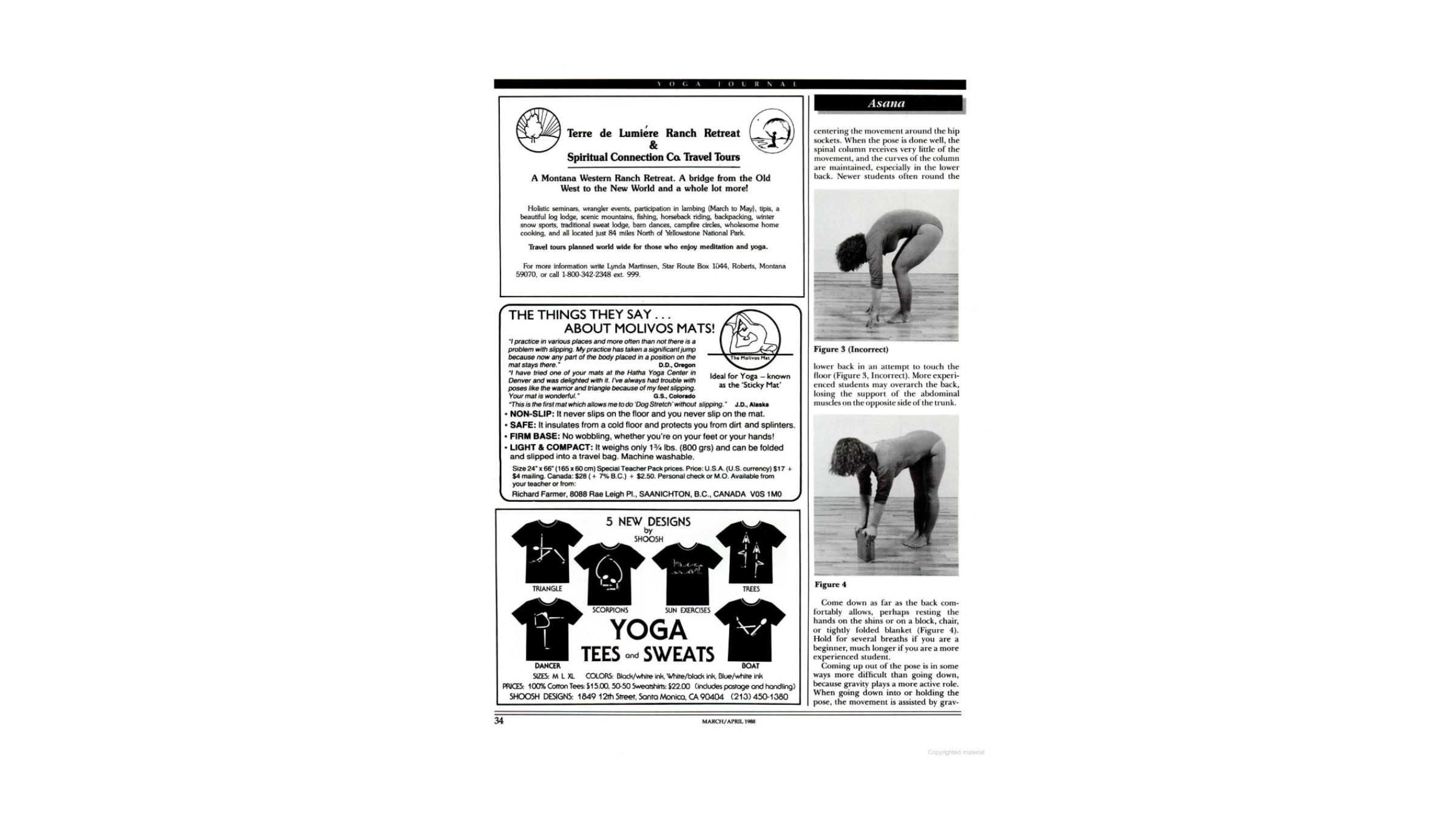
Start by placing the feet together. Bend forward slowly with an exhalation, centering the movement around the hip sockets. When the pose is done well, the spinal column receives very little of the movement, and the curves of the column are maintained, especially in the lower back. Newer students often round the lower back in an attempt to touch the floor (Figure 3, Incorrect). More experienced students may overarch the back, losing the support of the abdominal muscles on the opposite side of the trunk.
Come down as far as the back comfortably allows, perhaps resting the hands on the shins or on a block, chair, or tightly folded blanket (Figure 4). Hold for several breaths if you are a beginner, much longer if you are a more experienced student.
Coming up out of the pose is in some ways more difficult than going down, because gravity plays a more active role. When going down into or holding the pose, the movement is assisted by gravity. Coming up, the body moves against gravity, and the muscles work harder as you approach the vertical. Therefore, take care when coming up to maintain the curves of the column, especially in the lumbar region. To reduce the leverage on the lower back, contract the abdominal muscles slightly.
Another way to reduce the leverage on the lower back is to vary the position of the arms. For the least work for back muscles and the least strain on soft tissues of the column, such as the intervertebral discs, keep the arms straight at the sides when coming up. Another, slightly more stressful variation is to bend the elbows and grasp them with the opposite hands, forming a square around the head. The most stressful way is to extend the arms in front of the body, in line with the ears. Though not necessarily to be avoided, this variation requires special care and is usually not the best one for beginners.
Come out of the pose at a moderate speed while inhaling. If you get dizzy, you may be moving too fast, or your blood pressure may be naturally quite low. If you have low blood pressure, practice the pose gradually, supporting yourself at first halfway down on a chair, then, as your practice progresses, slowly coming farther and farther down. Come up in stages: Stop halfway, rest, then proceed slowly up. The key is to allow the body to adapt to the vertical position, while keeping plenty of blood and oxygen in the brain.
A restful way to practice this pose is to place the buttocks against the wall, with the feet about one foot apart and one foot from the wall. Then hang the spine forward in a relaxed manner. This position is quieting for most students, except those with very tight hamstrings, who should use the support of a chair.
Be careful how you hold your neck in Uttanasana. If the neck is tense, the brain will feel tense. Keep the pose long and the body relaxed at all times.
One way to vary Uttanasana is to vary the distance between the feet. Classically, the pose is taught with the feet together, but this position is hard for stiffer students. Try practicing Uttanasana with the feet spread so that the outsides of the feet are in line with the outer edges of the hips. The feet can then be gradually brought in a few inches as the pose is practiced several times in succession.
NOTE
- B. K. S. Iyengar, Light on Yoga (New York: Schocken Books, 1979), p. 93.








 English (US) ·
  French (CA) ·