

PROTECT YOUR DNA WITH QUANTUM TECHNOLOGY
Orgo-Life the new way to the future Advertising by Adpathway
THE GEAR
Jersey: Thor MX Launchmode
Pants: Thor MX Launchmode
Helmet: Alpinestars Supertech M10
Goggles: Alpinestars Supertech
Boots: Alpinestars Tech 10
Q: FIRST AND FOREMOST, IS THE 2026 KTM 450SXF BETTER THAN THE 2025 450SXF?
A: The 2026 KTM 450SXF is identical to the 2025 version. There are a few minor technical touches that are helpful but not game changers. In truth, the biggest improvement came in 2025 when KTM axed the super-stiff 2024 frame. The product managers for the 2024 KTM 450SXF must have had a target audience in mind, but on what planet did they find riders who were willing to wait 10 hours before the chassis had a semblance of rideability? But, as is often said, you learn as much from your mistakes as you do from your successes. The good news is that rider complaints about the 2024 chassis came from as high up as their factory riders to as low as their paying customers. The message was, “Fix the frame’s rigidity.” And for 2025–2026, they did.
Q: DID KTM REALLY THROW THE 2024 FRAME AWAY TO CURE THE PROBLEM?
A: Yes, and it was a big deal to react to consumer complaints after just two years on the showroom floors. It is no secret that the “Big Four” Japanese brands work on four-year development schedules. If a new model is released in 2020, it will not see significant changes until 2024. In KTM’s case, they threw the 2024 frame out the window and replaced it with the completely renovated 2025 KTM 450SXF.
KTM was lucky, because they didn’t have to do anything about their engine. It was a 60-horsepower powerplant with a broad, linear and ultra-manageable powerband. Any updates it needed could be done with ancillary components, such as ECU maps, a reconfigured Quickshift, throttle body or minor reliability tweaks. No manufacturer wants to make major changes to its powerplant—unless the market deems the current version untenable. And even then, the corporate pencil pushers will point out that it will cost 10 million dollars to test, design and build a new engine.
Take Suzuki’s reluctance to put electric starters on their two remaining motocross models. They don’t want to do it, because electric starting would require all-new engine cases, electronics, batteries and gear combinations to connect the starter motor of the flywheel. And once they redesigned the cases, it would be foolish not to update the rest of the engine to finger-followers, offset cranks and a new layout. They looked at the upfront costs of a new RM-Z450 engine and most likely decided that they could use those millions to get a running start on developing an all-electric 2028 bike.
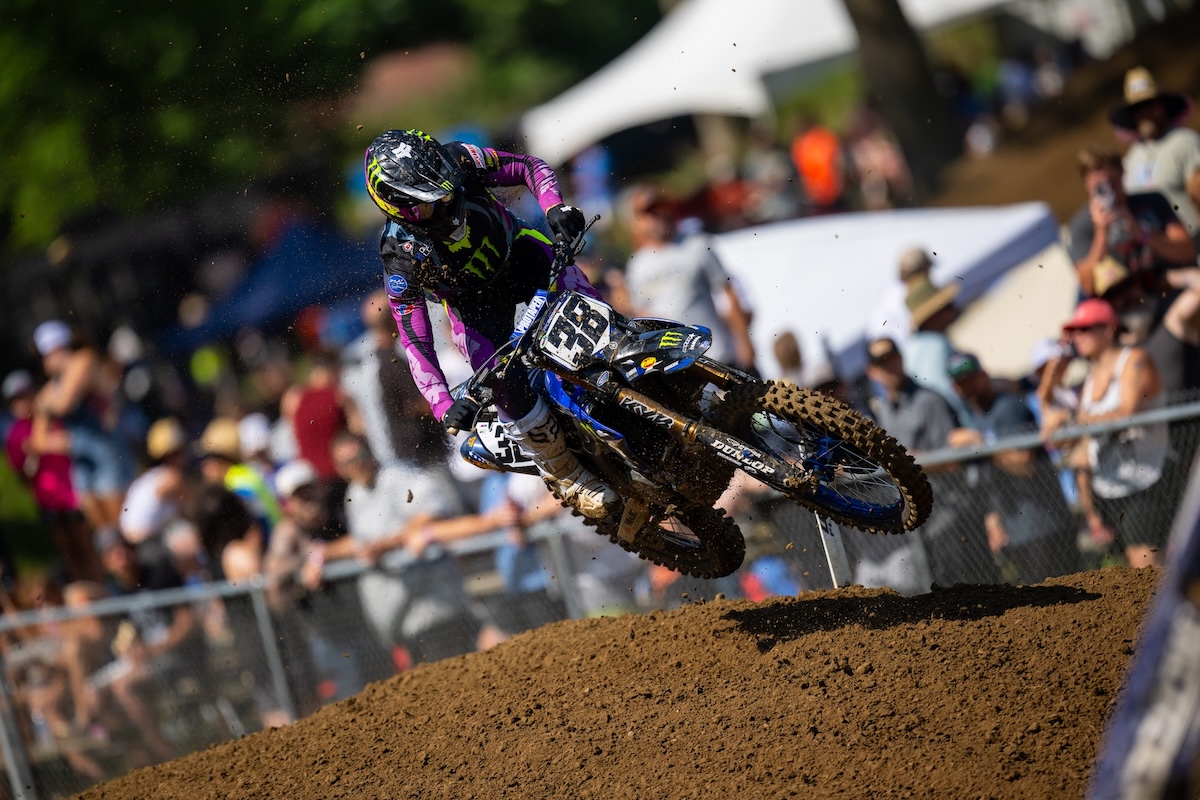
KTM 450SXF
Yamaha, on the other hand, decided to keep building two-strokes—in large part because their 2006 machines had stout engines and creative plug-and-play frames. They gambled that the major components of the 2006 YZ125 and YZ250 would hold their value, especially since they wouldn’t face any competition from Suzuki, Kawasaki or Honda two-strokes (and back in 2006, Yamaha wasn’t concerned about what KTM might do). Paradoxically, Yamaha totally updated the YZ450F in 2023. Kawasaki introduced a new KX450 in 2024, and Honda introduced a new CRF450 for 2025.
As a rule, the Austrians bikes do not live by the industry-standard, four-year production cycle like the Japanese brands. Historically, KTM makes changes in a much shorter cycle and almost always when issues arise that demand their attention. But, their engines often remain the same for as many as six years or more. A new frame in 2023 and a total revision of it in 2025 would be out of the question at a Japanese brand, but KTM doesn’t make oil tankers, automobiles, pianos, lawnmowers or marine engines. They make motorcycles, and mostly off-road motorcycles. That is what brought them to the party.
Q: WHAT’S NEW ON THE 2026 KTM 450SXF CHASSIS?
A: First of all, there are two distinct KTM frames as of late. The first one was released in 2023 and was highlighted by an increase in stiffness—theoretically to appeal more to pro riders. They made a lot of changes to the 2022 frame to make the 2023 version stiffer. Need a list?
- Forged plates on top of the frame’s backbone, with similar plates on the downtube.
- A new forged shock tower that separated the rear suspension loads from the head tube of the frame.
- Two symmetrical frame tubes that ran from the shock tower down to the footpeg gussets on both sides of the bike.
- Forged motor mounts welded to that frame that ensured that the engine was a stressed member of the frame.
- Thick, triangular head stays that locked the engine in place.
A second frame was introduced on the 2024-1/2 KTM 450SXF Factory Edition and became the 2025 KTM frame. It focused on remedying the five stiffness-producing updates on the 2023 frame. The goal was to build a more resilient chassis that absorbed more energy, cut down on kickback and didn’t require 10 hours of break-in time. Here is what the KTM engineers did for 2025 and kept for 2026:
-
- The stiff, triangulated shock tower had relief holes cut into both sides of the shock tower. The goal was to make the central point of the chassis more flexible.
- To stiffen the head-tube area on the 2023–2024 KTM 450SXF, thick, forged steel plates were welded to the top of the frame’s backbone. They wrapped around the steering head and were joined by another forged plate below the head tube. For 2026, the forged plates remained (because they increase the strength of the head-tube area), but the thickness of the plates was reduced to give them more resilience.
- The two symmetrical frame tubes that ran from the shock tower down to the footpeg bracket got thinner wall thicknesses to put more spring into the chassis, both longitudinally and torsionally.
- Head stays are one of the most commonly changed frame components. These triangle-shaped plates are attached to the frame with two bolts and connected to the cylinder head to help bind the chassis together with the structural mass of the engine. On the 2025–2026 KTM 450SXF, the head stays have CNC-machined openings designed to soften up the feel and improve front and rear bite.
 THE 2026 KTM 450SXF IS A PROVEN PACKAGE BECAUSE IT IS THE SAME BIKE THAT WON THE 2025 MXA 450 SHOOTOUT.
- 5. KTM tilted the engine 2 degrees rearward and moved it down 3mm to lessen the 2022-and-earlier KTM’s tendency to squat under hard acceleration. This is unchanged through 2026, because the anti-chain torque made the chassis better in consecutive whoops, rutted corners and any time the throttle was held wide open; however, lowering the countershaft sprocket meant that the chain line had to angle downward at a steep angle to get the chain to the countershaft sprocket. The result was that the chain would eat through the swingarm’s buffer pad. For 2025 and 2026, KTM shaved the top of the swingarm down to make it lower, while the thickness of the buffer pad on top of the swingarm was increased to keep the chain from wearing through.
Q: WHAT DO ALL OF THESE FRAME CHANGES ACHIEVE?
A: A vast improvement in feel and comfort, improved chassis response, and mesmerizing controllability. The 2026 frame is more resilient in the first couple of rides and feels better than the 10-hour 2024 frame immediately. How much time and testing you put into your suspension can make the frame feel better or worse, but as it sits, it feels very compliant.
Q: WHY SHOULD THE KTM 450SXF BE ON YOUR MUST-HAVE LIST?
A: The KTM 450SXF engineers spec’ed Rolls Royce-level components. The bike has the strongest brakes, braided steel hoses and the most robust clutch (with a one-piece, CNC-machined steel basket and a machined-in primary gear built in). The transmission comes from Formula 1 supplier Pankl. The KTM’s airbox has been copied by almost every other brand. The suspension can be adjusted by hand. It also offers clutch-less shifting (thanks to Quick Shift), split CNC-machined triple clamps, quick-release fuel lines, and our favorite ODI lock-on grips.
For 2025–2026, KTM resolved all of our complaints about the rigid chassis. It doesn’t feel like a completely new frame on the track, as the geometry is still the same, but now it is more flexible and compliant. It’s much more comfortable in the rough stuff, and once you dial in the forks, the bike is very balanced. The stock KTM suspension is racy. With the WP air forks, our test riders can adjust the settings based on track conditions, and the actual valving of the stock suspension, front and rear, has adequate hold-up for a stock bike.
Behind the Yamaha, the KTM has the second-most exciting engine on the track, but KTM’s philosophy is the opposite of Yamaha’s. KTM’s broad, smooth, torquey and supremely manageable powerband is not the revelation in brute power that the YZ450F embodies; instead, it is a study in usable power.
 This is a 60-horsepower engine with a broad, linear and ultra-manageable powerband.
 Most of the complaints about KTM’s WP Air forks have been resolved by the creative new internals.
Q: WHAT ELSE IS NEW ON THE 2026 KTM 450SXF?
A: Although Yamaha has taken the lead over the past few years when it comes to engine tuning via Wi-Fi, KTM’s new Connectivity Unit Offroad (CUO) can supply beaucoup engine-management options, and riders can access different levels of throttle response, traction control, launch control and engine braking. Riders can also engage preset maps for sand, gravel, hardpack and wet dirt. Additionally, the 2026 KTM 450SXF harnesses the power of LitPro to collect data about speed, acceleration, deceleration, average speed, G-forces, airtime, jump height, gearing, rpm, throttle position, water temperature and traction control. Best of all, LitPro can use its front-fender-mounted GPS unit to map the track you are riding on and play back the lines you use on every lap. It should be noted that the KTM Connectivity Unit Offroad doesn’t come on the stock 2026 KTM 450SXF. The retrofit CUO unit retails for $249.99, and to access the high-end LitPro features, you need a $69.99 annual subscription from Apple’s App Store and Google Play.
 The 2026 KTM 450SXF is an awesome motocross machine with a perfectly balanced chassis and a powerband that meters out usable power when necessary.
Q: THE HATE LIST:
A: What we don’t like.
- Start/stop buttons. If you don’t like having the kill button on the right side of the handlebars, Nihilo Concepts and Ride Engineering make separate start and stop buttons that retrofit, so you can put the kill button back on the left side.
- Finding neutral. Getting the transmission into neutral on the starting line can be hard. It resists being snicked into gear. Our solution is to rev the engine with the clutch pulled in, and when the rpm peak, we shift into neutral before the rpm drop.
- Gas cap. The gas cap sticks—sometimes to the extent that you can’t get it off at the gas station.
- Radiator cap. Our 2026 KTM 350SXF (tested in the February issue) came with a unique thread-on radiator cap. A month later, we got a 2026 KTM 450SXF that still had the previous, hard-to-use radiator cap that came from the mini-bikes. We questioned KTM about the discrepancy in the two radiator caps, and they told us that the 350SXF thread-on cap was the actual 2026 component. The early-release KTM 450SXF still had the old cap, but KTM assured us that as production ramps up, all the 2026 bikes will come with the thread-on radiator cap.
- Spokes. KTM’s spokes come loose all the time. If you can’t check all the spokes, be sure to check the spokes closest to the rear rim lock. If those spokes are loose, you need to tighten all the spokes.
- Seat height. A massive number of potential KTM racers are disenfranchised by the seat height of the KTM 450SXF. The average height of males in the USA is 5 feet, 9 inches. If you are shorter than that, odds are that your feet won’t be able to touch the ground on the starting line.
- Shock clicker access. Whoever designed the KTM, GasGas and Husqvarna side panels didn’t understand that the high-speed and low-speed shock clickers shouldn’t be covered up by plastic bodywork. Motocross racers want easy access to the shock’s compression clickers, which is why the KTM engineering department made them hand adjustable. How many years can the plastic designers keep making the same mistake without getting fired?
Q: THE LIKE LIST:
A: What we do like.
- Shock collar. WP’s latest shock collar is much easier to use and more durable than it was in the past.
- Vented airbox cover. You get two airbox covers when you buy a KTM: a stock cover and an optional vented cover. MXA test riders always prefer the vented cover, except on dusty or wet tracks.
- Washing. The giant air vents below the seat are hard to seal off when you pressure-wash your bike. We run Twin Air’s plastic airbox covers to avoid getting water in the engine.
- Frame guards. Most MXA test riders like KTM’s fancy frame guards, but we have test riders who remove them because the thickness of the plastic pushes their feet outward (if you remove them, you will be surprised by how much narrower the bike feels at your boots).
- Mapping. The two embedded maps on the left-side switchgear provide two pretty distinct options. Most MXA test riders prefer the white map.
Q: WHAT DO WE REALLY THINK?
A: Boiled down to its simplest terms, the 2026 KTM 450SXF—financial difficulties aside—is an awesome motocross machine with a perfectly balanced chassis and a powerband that meters out usable power when necessary and an incredible rush of power when demanded.
It is never too powerful, never too weak, never too twitchy and never misses a shift. A close look at its European and Japanese competition will reveal beaucoup ideas stolen directly from KTM, including Belleville-sprung hydraulic clutches, airbox designs, easy-access compression clickers, and one-tool shock preload rings.
“Torquey, broad, powerful and fun” are the watchwords for the 2026 KTM 450SXF. It is a joy to ride, especially in a class where the competition’s engines are either too hard-hitting, barely hitting at all or weak on top. This is the do-it-all engine of the 450 class.
MXA’S 2026 KTM 450SXF SETUP SPECS
This is how we set up our 2026 KTM 450SXF suspension for racing. We offer it as a guide to help you find your own sweet spot.
WP AER FORK SETTINGS
There is a learning curve to getting the most out of the WP XACT air forks. The KTM WP XACT air fork has one Schrader valve to put air in and take air out. The right fork leg is strictly damping, and the left leg is air only. KTM has a sticker on the air leg to guide you to the recommended air pressure. It is a good starting point, but it’s just a suggestion, not an ironclad law. MXA has test riders who run as much as 165 psi and test riders who run as low as 135 psi.
The 2026 forks have the potential to be great. For hardcore racing, we recommend this fork setup for an average rider on the 2026 KTM 450SXF:
- Spring rate: 158 psi (expert), 152 psi (intermediate), 145 psi (vet), 138 psi (novice)
- Compression: 14 clicks out (12 clicks out)
- Rebound: 15 clicks out (18 clicks out)
- Fork-leg height: Third line
Notes: We run a zip-tie on the right leg to measure fork travel, which is an indicator of whether you have too much or too little air pressure.
WP SHOCK SETTINGS
MXA test riders like the overall feel of the WP rear shock, especially since KTM lowered the shock spring rate from 48 N/mm to 45 N/mm. WP did make some technical changes to the 2026 shock to make high-speed compression damping less finicky.
We run the low-speed compression on 17 clicks out, the high-speed compression 1-1/2 turns out, the rebound on 17 clicks out and set the sag at 105mm.
For hardcore racing, we recommend this shock setup for the 2026 KTM 450SXF:
- Spring rate: 45 N/mm (for riders 175 pounds and up), 42 N/mm (for riders under 175 pounds)
- Race sag: 105mm
- Hi-compression: 1-1/2 turns out
- Lo-compression: 17 clicks out (stock 15 clicks out)
- Rebound: 15 clicks out
Notes: When we have doubts about the shock’s compression damping, we focus on changing the high-speed compression, not the low-speed. The new shock linkage, with its reduced friction, requires one or two clicks in on the compression to feel right.













 English (US) ·
  French (CA) ·