

 19 hours ago
1
19 hours ago
1
PROTECT YOUR DNA WITH QUANTUM TECHNOLOGY
Orgo-Life the new way to the future Advertising by AdpathwayPublished August 30, 2026 09:01PM
In Yoga Journal’s Archives series, we share a curated collection of articles originally published in past issues beginning in 1975. This article about Virasana (Hero Pose) first appeared in the September-October 1979 issue of Yoga Journal. Find more of our Archives here.
A classic pose for meditation, Virasana, the Hero Pose, is often quite difficult for the adult Westerner to practice. Yet children of all cultures choose this asana, or pose, spontaneously during play, underscoring its naturalness for the human body. Contrary to what its name implies, Virasana has a soothing effect upon the mind and body.
Learning to sit still and well in this asana of repose is a discipline within itself which captures the larger meaning of yoga. In the beginning the student is uncomfortable, restless in the pose, and the mind questions the value of attempting something so difficult. With continued practice, the pose becomes physically easier so one is able to do it with a quieter mind. Along the way, one learns patience, steadfastness, and the value of persistence. As the mind grows quieter, one is able to observe the inner self.
Yoga teaches that body and mind must be in stillness in order for the soul (atman) to be experienced. This stillness is the result of working through stiffness of the body and impatience or reticence of the mind. Without stillness of body and mind, how can true stillness be reflected by the soul? This is what yoga is all about.
My experience has taught me that rarely, if ever, does the mind quiet itself. It is loath to give up thought, the processing and integrating of information. It is only by an act of will, that ephemeral something which is partly mental and partly beyond the mind, that one can still the mind. One approach to strengthening the will is to practice asanas such as Virasana. This works partly because of the discomfort that must be overcome. While holding a mildly uncomfortable pose, one is able to observe how the mind rebels and then subsides, rebels and subsides, in the rhythm yogis term “vrttis” or “waves.” Holding a pose during these waves strengthens the will without strengthening the ego or “I” sense. This is one way in which yoga is unique. Quietness in Virasana can help to dissipate the clouds which are hiding the pure self.
How to Practice Virasana (Hero Pose)
Whether practiced as a pose of meditation or as a pose to help the knees, Virasana is an important pose, especially for the beginner. It balances the emphasis hatha yoga places on opening the hips by bringing the hips to a more neutral, slightly internally rotated position. But also, consider that by practicing Virasana you can regain the flexibility of your joints and mind, which one associates with freedom. Freedom is what yoga is all about.
Beginners
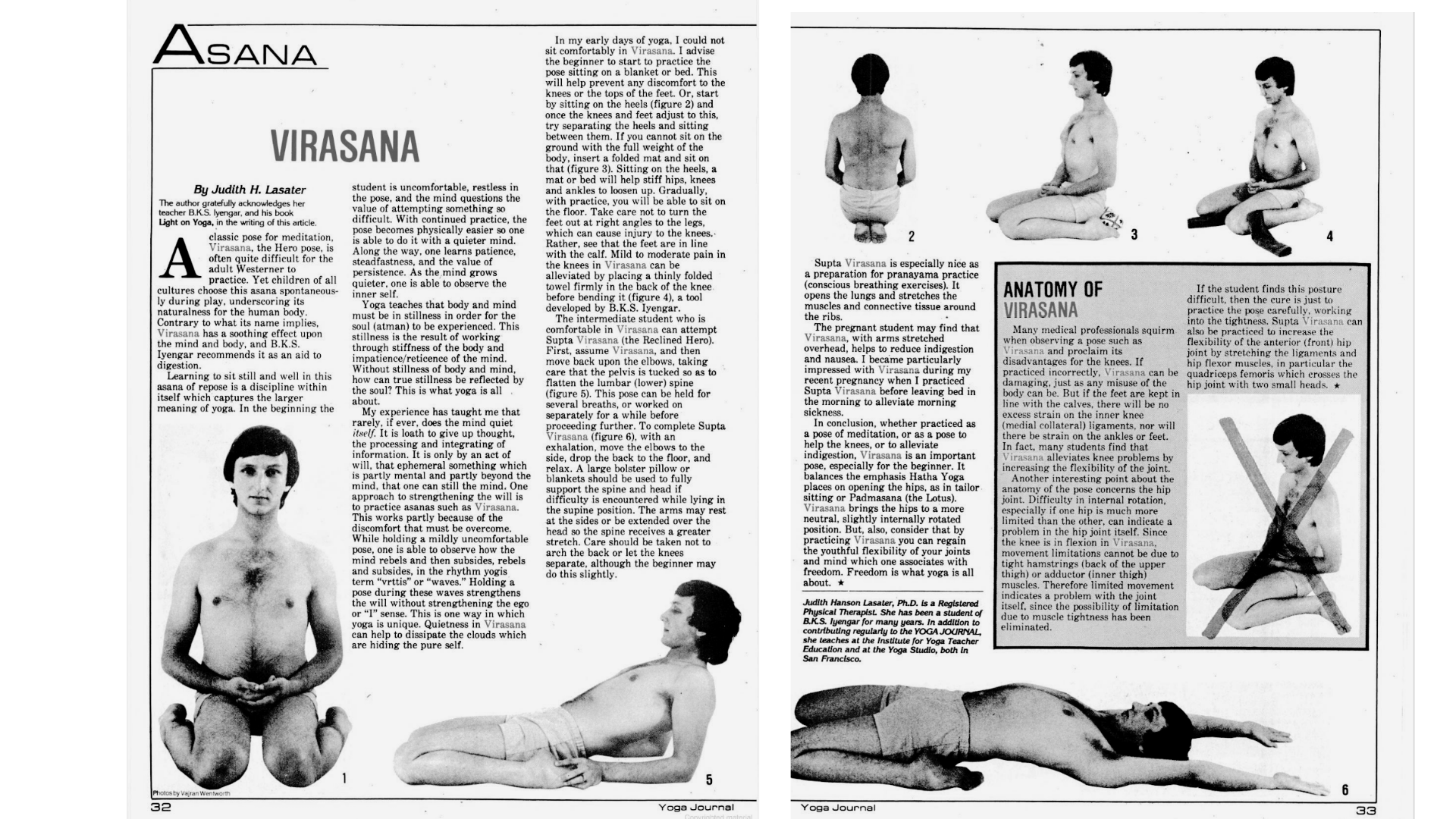
In my early days of yoga, I could not sit comfortably in Virasana. I advise the beginner to start to practice the pose sitting on a blanket or bed. This will help prevent any discomfort to the knees or the tops of the feet. Or start by sitting on the heels (Figure 2) and once the knees and feet adjust to this, try separating the heels and sitting between them. If you cannot sit on the ground with the full weight of the body, insert a folded mat and sit on that (Figure 3). Sitting on the heels, a mat or bed will help stiff hips, knees and ankles to loosen up.
Gradually, with practice, you will be able to sit on the floor. Take care not to turn the feet out at right angles to the legs, which can cause injury to the knees. Rather, see that the feet are in line with the calf. Mild to moderate pain in the knees in Virasana can be alleviated by placing a thinly folded towel firmly in the back of the knee before bending it (Figure 4), a tool developed by B.K.S. Iyengar.
Intermediate Students
The intermediate student who is comfortable in Virasana can attempt Supta Virasana (the Reclined Hero). First, assume Virasana, and then move back upon the elbows, taking care that the pelvis is tucked so as to flatten the lumbar (lower) spine (Figure 5). This pose can be held for several breaths, or worked on separately for a while before proceeding further. To complete Supta Virasana (Figure 6), with an exhalation, move the elbows to the side, drop the back to the floor, and relax. A large bolster pillow or blankets should be used to fully support the spine and head if difficulty is encountered while lying in the supine position. The arms may rest at the sides or be extended over the head so the spine receives a greater stretch. Care should be taken not to arch the back or let the knees separate, although the beginner may do this slightly.
Supta Virasana is especially nice as a preparation for pranayama practice (conscious breathing exercises). It opens the lungs and stretches the muscles and connective tissue around the ribs. B.K.S. Iyengar recommends it as an aid to digestion.
The pregnant student may find that Virasana, with arms stretched overhead, helps to reduce indigestion and nausea. I became particularly impressed with Virasana during my recent pregnancy when I practiced Supta Virasana before leaving bed in the morning to alleviate morning sickness.
Benefits of Virasana
Many medical professionals squirm when observing a pose such as Virasana and proclaim its disadvantages for the knees. If practiced incorrectly, Virasana can be damaging, just as any misuse of the body can be. But if the feet are kept in line with the calves, there will be no excess strain on the inner knee (medial collateral) ligaments, nor will there be strain on the ankles or feet. In fact, many students find that Virasana alleviates knee problems by increasing the flexibility of the joint.
If the student finds this posture difficult, then the cure is to practice the pose carefully, working into the tightness. Supta Virasana can also be practiced to increase the flexibility of the anterior (front) hip joint by stretching the ligaments and hip flexor muscles, in particular the quadriceps femoris, which crosses the hip joint with two small heads.
The author gratefully acknowledges her teacher B.K.S. Iyengar and his book Light on Yoga in the writing of this article.









 English (US) ·
  French (CA) ·